
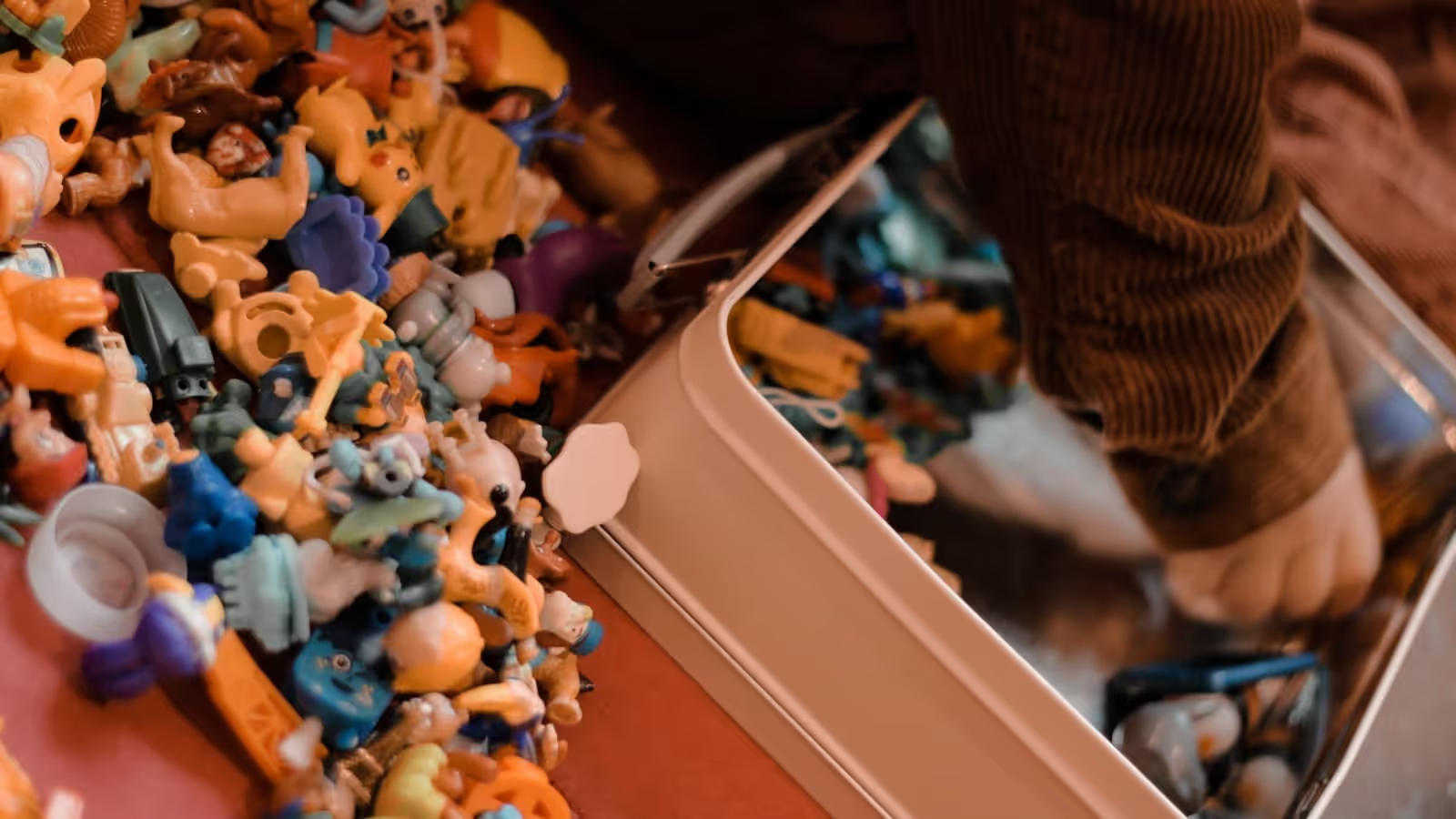
A Labubu arrives sealed, and you do not get to choose which one is inside. That single design decision is the whole difference between blind box collecting and ordinary collecting, because it converts a purchase into a gamble, and a gamble runs on different machinery to a shopping trip. Collecting itself is old, ordinary and frequently good for people, and most collectors are entirely fine. What almost no coverage of the Pop Mart boom explains is why the blind part changes the psychology, which is the only part of this actually worth understanding.
Collecting is not the problem
Collecting is a normal behaviour with a long history and a decent record, and most people who do it get something real from it. It builds expertise, since anybody serious about a collection ends up knowing more about their subject than almost everyone around them. It builds identity, because a shelf is a statement about taste that does not require you to say anything out loud. And it builds community, which for a great many collectors is the actual point rather than a side effect.
None of that is weakened by the object being a small vinyl figure rather than a first edition or a rare stamp. The snobbery about what is worth collecting is a social opinion, not a psychological finding. Our guide to self-worth covers why an identity built on something you genuinely care about holds up better than one built on what other people rate.
So this is not an argument against collecting, and the practical suggestions further down do not involve giving it up. It is about one specific mechanism that ordinary collecting does not contain.
What the sealed box actually changes
The sealed box removes your choice, and in removing it, turns a purchase into a bet. Buy a specific figure and you know exactly what you are getting; the transaction is finished the moment you have it. Buy a sealed box and you are buying an outcome instead, and that outcome stays unknown until you open it.
This sounds like a small change and it is not. A known purchase is settled at the till, while an unknown one is only resolved at the moment of opening, which quietly relocates the interesting part of the experience from owning the figure to finding out which figure it is. Collectors notice this without having a name for it. The box is more exciting than the shelf.
Why unpredictable rewards are so hard to stop
Because a reward that arrives unpredictably produces more persistent behaviour than one that arrives on a fixed schedule, and it fades far more slowly once the rewards dry up. This is one of the oldest findings in behavioural psychology, mapped in detail in the 1950s laboratory work on how different reward schedules generate different patterns of responding. [ferster-skinner] The relevant pattern has a name: a variable ratio schedule, in which the payoff comes after an unpredictable number of attempts.
The reason it resists stopping is counterintuitive and worth spelling out. If a vending machine gives you a drink every time and then stops, you work out within two attempts that it is broken, because the failure is information. If the payoff was never predictable in the first place, no run of failures tells you anything at all, since a long run of misses is precisely what the schedule already produces. There is no quantity of disappointing boxes that constitutes evidence. That is the engine underneath “just one more”, and it is why one more feels qualitatively different from simply buying the figure you wanted.
The secondary market sharpens it further. Once a rare variant carries a resale price, the box is no longer holding only a figure you might like, it is holding a figure with a number attached, and the question shifts from whether you got a nice one to whether you got the valuable one. That version of the question has a right answer, which is exactly what makes missing it feel like losing rather than like not winning.
The near miss, and why almost is worse than nowhere near
An outcome that falls just short increases the urge to go again rather than discouraging it. Near misses recruit reward-related brain circuitry in a pattern resembling a win, despite being losses. [clark-nearmiss] Pulling the other colourway of the figure you were after is a near miss. Pulling your fifth duplicate is a plain one.
The felt difference between those two outcomes is enormous and the informational difference is zero. Both are the same result: not the figure you wanted. Our article on the psychology of the lottery covers the gambling side of this properly, including what near misses do to the odds people believe they are facing, so it is not repeated here. The narrower point for collecting is that a series built around one chase figure manufactures near misses constantly, by construction, because every other figure in the set is a version of nearly.
Why the figure you chased stops feeling good so fast
Because wanting something and having it are handled by separable systems, and only one of them is built to last. Research on reward separates “wanting” from “liking”: the circuitry generating the pull towards something is not the circuitry producing the pleasure of getting it, and the two can move independently of each other. [berridge-liking] Wanting is loud, triggered by cues, and renewable. Liking is quieter, and it is short.
The second half of the answer is adaptation. People adjust to changed circumstances considerably faster than they expect to, and the research on well-being finds a strong pull back towards a person’s own baseline after both good events and bad ones, though the return is neither complete nor identical for everybody. [diener-adaptation] A shelf is a changed circumstance. The figure that was the entire point in the queue is scenery within a fortnight, and the only object in the room still carrying any wanting is the one that has not been opened.
A schematic of the pattern described in this article, drawn to show the shape of the gap rather than measured values.
A collection organised around a missing piece
A set with one figure missing is a machine for generating wanting, because the gap is the most interesting thing on the shelf. This is the point at which blind box collecting stops being about figures and starts touching self-worth, which is why this article sits here rather than under addiction.
The arrangement has a design flaw that is easy to miss while you are inside it. If the good feeling is scheduled to arrive on completion, and the collection is defined by what it is missing, then the feeling is permanently one purchase away by construction. Complete a series and a new one launches, which is a business model rather than a betrayal, but it does mean the destination moves every time you approach it. People describe this as never quite enjoying the collection they already own.
There is a status layer too, and it is worth being honest that it is often the good part. Knowing the variants, spotting a fake, being the person others ask, having something to talk about with people who care about the same thing: that is genuine value and it is most of why collecting communities work. The version that hurts is narrower. It is watching somebody else unbox the exact figure you have been chasing, feeling the drop, and then feeling ashamed of having felt it, which is usually the more damaging of the two. Our article on why other people’s good news can hurt covers that specific sequence.
Is this collecting-shaped or gambling-shaped?
The useful question is not how much you have spent but what shape the behaviour has, because the same amount of money can sit on either side of this table. Read both columns and see which one describes the last few months more accurately.
| Collecting-shaped | Gambling-shaped |
|---|---|
| You buy the figures you want, from whoever has them | You buy sealed boxes and hope |
| The amount is decided before you go in | The amount is decided by how the last box went |
| A duplicate is something to trade | A duplicate is a reason to open another |
| You can say what you own and why you chose it | You can say what is missing, faster than what you own |
| Other collectors are the best part of it | You have stopped telling other collectors what you spent |
| A bad month means you buy nothing and mind very little | A bad month means money promised elsewhere has gone on boxes |
Nobody sits purely in one column, and drifting a row or two to the right during a launch week is not a crisis. The rows that carry the most weight are the last two, because concealment and committed money are the two that predict where this goes rather than describing where it currently is.
What helps, and none of it is quitting
Three things, and all of them keep the collecting.
Decide the number before you go in. Not a monthly resolution, an actual figure agreed with yourself before the first box, because the decision made beforehand and the decision made after the third box are made by different people. Written down beats remembered, and cash beats card for the same reason.
Buy the specific figure, not the sealed box. When you genuinely want one particular figure, buy that one on the secondary market. This removes the gamble completely, it usually costs less than the chase would have, and it is the single most effective change available here precisely because it changes the format rather than requiring willpower against it. Sealed boxes are for when you want the surprise itself.
Notice which thing you are buying. There is a real difference between wanting the object and wanting the opening, and both are legitimate. The tell is what happens if a friend offers you the figure you have been chasing, at cost, right now. Relief means you wanted the object. Slight deflation means you wanted the opening, and no number of boxes will settle that, because opening is the thing you are buying and it is consumed instantly.
No screener on this site covers collecting, and pointing you at one that measures something else would be misleading. The free self-assessment hub lists what does exist, covering anxiety, depression, stress, sleep, burnout, self-esteem and loneliness. For the general question of where a strong habit ends and a problem starts, our article on habit versus addiction sets out the distinction clinicians actually use.
When to seek help
Speak to a doctor or a therapist if the spending has gone past what you can afford, if you have hidden it from somebody who would have an opinion, or if you have bought more boxes to recover a bad run. Those three are gambling-shaped rather than collecting-shaped, and they are worth acting on whatever the amounts involved, because they describe the direction rather than the current position.
Go sooner if money already promised to rent, food or a bill has gone on boxes, if you have borrowed to keep buying, or if somebody close to you has raised it and you found yourself managing the conversation instead of answering it. When you ask for help, give the actual figure and the period it covers. A vague description reliably produces vague advice.
Contact your local emergency services or a crisis helpline if you feel unsafe or have thoughts of harming yourself.
How MyFreud can help
MyFreud is a mobile app that helps you find solutions to problems that have affected your mind and productivity. Live coaching sessions give you somewhere to work out whether you are buying the object or the opening, which is the question that decides what actually helps, and each one ends with an actionable plan rather than a resolution to be more disciplined. Daily tracking puts the spend and the mood on the same screen, which is the comparison memory is worst at. The notepad is where the number you decided on lives, so it exists before the shop does.
Download MyFreud and start today: App Store or Google Play.