
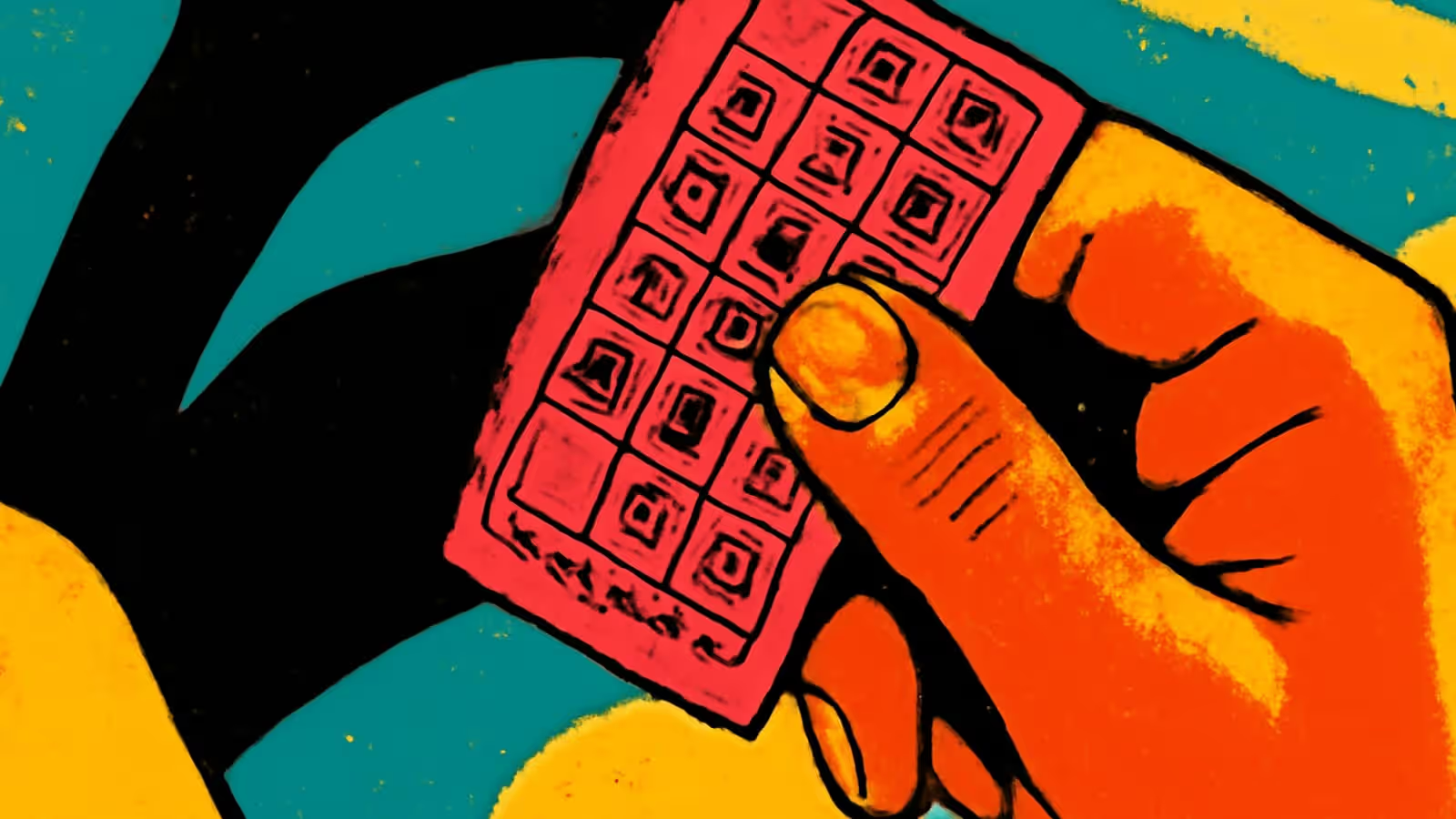
“When is the next Powerball drawing” was one of the most searched phrases in the United States this week, which is a reliable sign that the jackpot has climbed. It is worth being precise about what people are buying at that counter, because it is not really a chance of winning. It is the two days between the ticket and the draw, and that turns out to be the whole mechanism.
What you are actually buying
You are buying the interval, not the outcome. Between the moment you hold the ticket and the moment of the draw, you own a period in which imagining a completely different life is licensed rather than silly, and that is the product doing the work.
This is why the ticket keeps feeling worth it to people who can recite the odds perfectly well. The anticipation is not a miscalculation of probability; it is a separate thing that happens alongside the calculation and does not consult it. Ask somebody what they would do with the money and they answer in detail, immediately. Ask them their chances and they will tell you, accurately, that they have none. Both are true at once and neither disturbs the other.
Why the odds do not protect you
Because the system generating the feeling is older and less numerate than the one doing the arithmetic. Knowing a number and feeling its weight are different operations, and probabilities this extreme are effectively unimaginable: there is no experience in an ordinary life that corresponds to one in three hundred million, so the mind substitutes a picture instead.
That substitution is the thing to watch, because a vivid picture beats an accurate number nearly every time. The advertised jackpot is designed to be picturable, which is also why a bigger jackpot pulls in disproportionately more players despite the odds per ticket getting worse as the crowd grows, since more players means more shared prizes.
- Anticipation between buying and the draw 72%
- The purchase itself, and the ritual 21%
- The result 7%
A schematic of the mechanism described in this article, to show relative share rather than measured data.
The near miss, and why it works backwards
A near miss is an outcome that falls just short, and it does the opposite of what you would expect. Matching four numbers of six, or watching two reels line up and the third stop one position off, feels like evidence that you were close, and brain imaging finds that these events recruit reward-related circuitry in a pattern resembling an actual win. [clark-nearmiss]
The same effect is manufactured by construction wherever a sealed product hides a rare variant, which our piece on blind box collecting covers.
The behavioural consequence is that near misses increase further play rather than discouraging it. This is why so many games are built to produce them at a rate far above chance: scratch cards that reveal two of three matching symbols, reels weighted so the jackpot symbol appears just above or below the payline. In a genuinely random draw a near miss carries no information at all, since four numbers of six means precisely nothing about your next ticket. It simply feels like it does.
The useful thing to know is that “I was so close” is the sentence to notice in yourself. It is not an observation about the odds. It is the feeling the design was engineered to produce.
A schematic of the near-miss effect described in this article, not measured data.
Where ordinary play tips into harm
The line is behavioural rather than financial, which is the part most people get wrong. There is no spending figure that marks the boundary, because the same amount can be an unremarkable weekly habit for one person and a serious problem for another.
The markers that actually matter:
- Chasing. Playing to recover what you lost, rather than playing for the same reason you played the first time. This is the single most important sign.
- Concealment. Hiding the spend, or the frequency, from people who would have an opinion about it.
- Committed money. Using money already promised to rent, food or a bill.
- Escalation. Needing larger stakes or more tickets to get the feeling the smaller ones used to produce.
- Restlessness on stopping. Irritability or agitation when you try to cut down.
Gambling disorder is a recognised diagnosis and is the only addictive disorder in the current manual that involves no substance whatsoever. [apa-gambling] That is not a technicality: it reflects evidence that the same reward pathways are involved, and it means there is real treatment rather than only advice to have more willpower.
Which side of the line?
Tick anything true of the last few months. This is a reflection prompt rather than a screening tool, and it produces no diagnosis.
0 of 6 ticked
Three or more of these together is the pattern that gambling disorder describes, and the amount of money involved does not change that. It is treatable, and the treatments are specific rather than general, so speak to a doctor or a therapist and use these words rather than softer ones.
Chasing is the item that matters most, because it changes what you are playing for. If that one is ticked, a practical step now is worth more than a resolution later: separate the money, set a fixed limit before you play rather than during, and tell somebody the figure.
Nothing here matched, which is where most people who buy an occasional ticket sit. The one habit worth keeping is deciding the amount before the jackpot is announced rather than after.
What helps if it has become a problem
Treatment exists, it is specific, and it works better than resolve does. Cognitive behavioural approaches for gambling target the beliefs the games manufacture, particularly the sense that a near miss means something and that a run of losses makes a win more likely, and they pair that with practical control of access and money. [apa-gambling-help]
Three things tend to matter alongside treatment. Removing access is more effective than resisting it, so self-exclusion schemes and blocking software do real work. Telling one person the actual figure breaks the concealment that keeps the problem running. And treating a slip as information rather than as proof of failure is what stops one lapse becoming a return, which our article on why one slip turns into a return covers in detail. Our addiction guide sets out what treatment involves more broadly, and the psychology of sudden wealth covers the other end of this subject, which is what actually happens to the people who win.
When to seek help
Speak to a doctor or a therapist if you have been chasing losses, hiding what you spend, or using money committed to something else. Those three are worth acting on immediately regardless of the amounts, because they are the markers that predict where this goes rather than describing where it is.
Go sooner if debt is accumulating, if you have borrowed to gamble, or if someone close to you has raised it with you. Say the word gambling rather than stress when you ask, because it changes what you are offered.
Contact your local emergency services or a crisis helpline if you feel unsafe or have thoughts of harming yourself.
How MyFreud can help
MyFreud is a mobile app that helps you find solutions to problems that have affected your mind and productivity. Live coaching sessions give you somewhere to work out what the habit is actually doing for you, each one ends with an actionable plan rather than a resolution, daily tracking makes the pattern visible in a way memory reliably hides, and the notepad is where the real figure goes so it stops being vague.
Download MyFreud and start today: App Store or Google Play.