
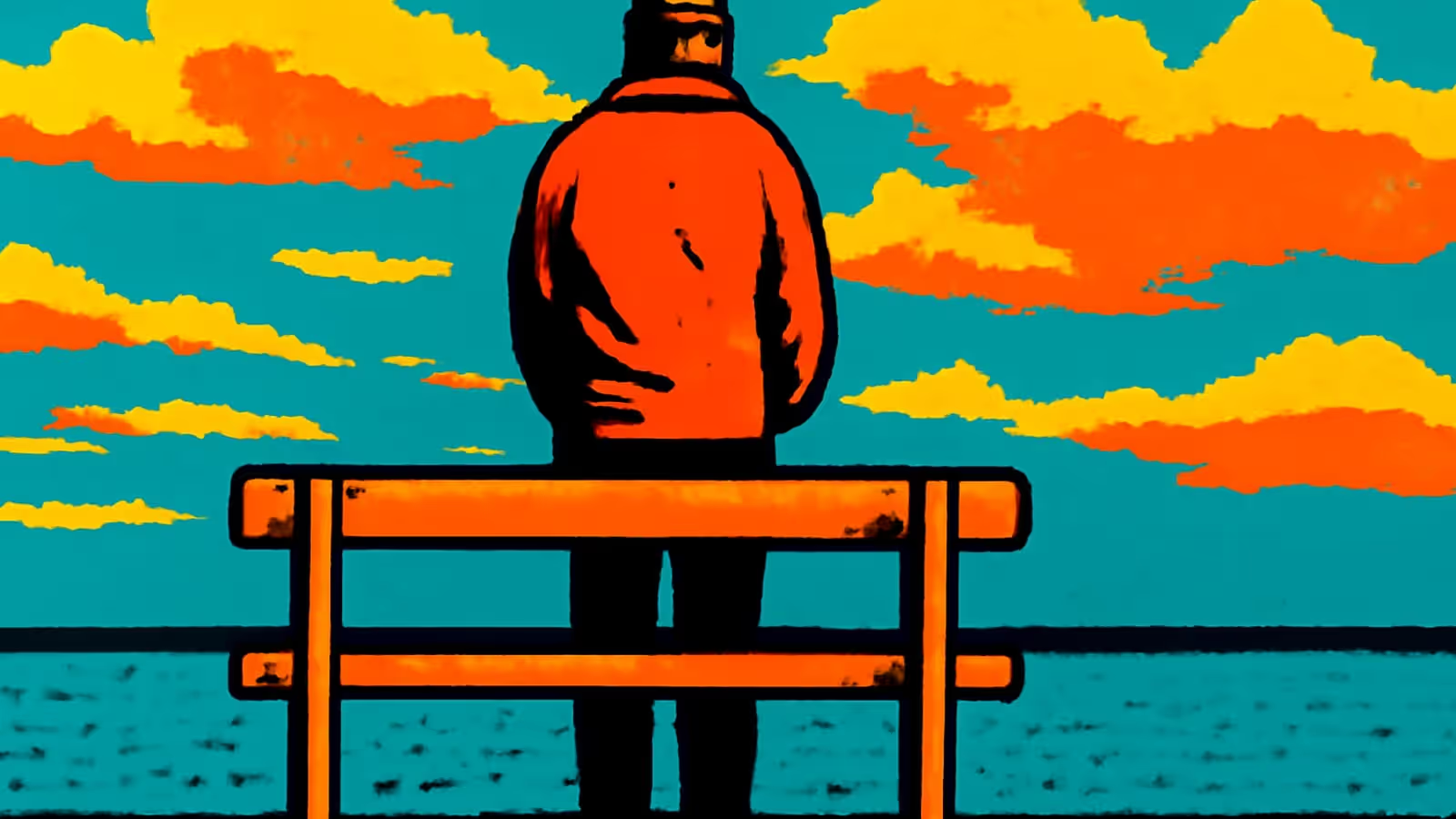
Loneliness is one of the most common forms of human distress, and one of the most stigmatised. People often feel ashamed to admit they are lonely, as though it were a personal failing rather than a near-universal experience. It is not a failing. In 2023 the United States Surgeon General issued a public health advisory describing loneliness and isolation as an epidemic, noting that about half of adults report experiencing loneliness and that weak social connection carries a risk to health comparable to smoking up to 15 cigarettes a day. [surgeon-general-2023-advisory] This guide explains what loneliness actually is, why it affects the body and mind so powerfully, who is most at risk, and, most usefully, what the evidence shows actually reduces it.
Loneliness is not the same as being alone
The single most important distinction is between loneliness and social isolation. Social isolation is objective: it describes how few social contacts a person actually has. Loneliness is subjective: it is the distressing feeling that your social connections fall short of what you want or need. The two often overlap, but not always. A person can be surrounded by people, in a busy office or even a marriage, and still feel profoundly lonely. Another can live alone, see few people, and feel content.
One response to it turns out to be built in. Why nostalgia helps more than it should covers the finding that loneliness triggers nostalgia and nostalgia then reduces loneliness.
This matters because solitude is not the enemy. Chosen, comfortable time alone can be restorative. Loneliness is specifically the gap between the connection you have and the connection you want. Recognising this reframes the problem away from simply being around more people and toward the quality and meaning of the relationships involved.
That subjective gap is exactly what the field’s standard research instrument was built to measure. Our guide to the UCLA Loneliness Scale covers what it actually asks, how it is scored, and how it relates to the short version used in our own quick check below.
Why loneliness affects physical health
The link between social connection and physical health is one of the most robust findings in health psychology. Holt-Lunstad and colleagues (2010) conducted a meta-analysis of 148 studies and found that people with stronger social relationships had a 50% greater likelihood of survival over the study periods than those with weaker connections, an effect size comparable to well-established risk factors such as smoking and exceeding many others such as obesity and physical inactivity. [holt-lunstad-2010-relationships]
A second meta-analysis by Holt-Lunstad and colleagues (2015) focused specifically on loneliness, social isolation, and living alone, and found each was associated with a meaningfully increased risk of early death: roughly a 26% increase for loneliness, 29% for social isolation, and 32% for living alone. [holt-lunstad-2015-mortality] The mechanisms are several. Chronic loneliness keeps the body’s stress systems activated, raising inflammation and blood pressure over time. It disrupts sleep, as the lonely brain stays subtly vigilant for threat. And it erodes the everyday health behaviours, eating well, exercising, attending appointments, that connected people tend to support in one another.
Loneliness and mental health
Loneliness and mental health are tightly, and bidirectionally, linked. Loneliness raises the risk of developing depression and anxiety, and depression and anxiety in turn make people withdraw, deepening loneliness. The Surgeon General’s 2023 advisory lists depression, anxiety, and dementia among the conditions for which social disconnection is an independent risk factor. [surgeon-general-2023-advisory]
The pathway runs partly through the same systems described above: disrupted sleep, chronic stress activation, and rumination. Our depression overview and anxiety hub cover those conditions in depth, and because loneliness so reliably disturbs rest, our sleep and mental health guide is often relevant too. The key clinical point is that loneliness is worth taking seriously in its own right, not dismissing as a symptom that will lift on its own once the depression is treated, because the two sustain each other.
Who is most affected, and why it may be rising
Loneliness is not confined to any one group, but some are more exposed. Young adults consistently report some of the highest levels, contrary to the stereotype that loneliness is mainly a problem of old age, although older adults facing bereavement, reduced mobility, and shrinking social networks remain highly vulnerable. Major life transitions, moving city, starting university, becoming a parent, retiring, losing a partner, are common triggers because they disrupt existing networks faster than new ones form.
The Surgeon General’s advisory points to broader structural shifts as well: declining participation in community organisations, more time spent alone, and changes in how technology mediates connection. Digital contact can support relationships, but when it displaces in-person connection it often leaves the underlying need unmet.
What actually helps
Here the evidence holds a genuine surprise. It is natural to assume the fix for loneliness is simply more social contact. Masi and colleagues (2011) conducted a meta-analysis of loneliness interventions and grouped them into four types: improving social skills, enhancing social support, increasing opportunities for social contact, and addressing maladaptive social cognition. The most effective approaches were those that targeted maladaptive social cognition, the unhelpful, often automatic thought patterns that loneliness creates, such as expecting rejection, reading neutral interactions as hostile, and withdrawing pre-emptively. [masi-2011-interventions]
This makes sense in light of how loneliness works. Prolonged loneliness puts the brain into a self-protective, threat-sensitive state that subtly biases a person to perceive others as less warm and more critical than they are. That bias then drives the very withdrawal that perpetuates the loneliness. Interventions rooted in cognitive behavioural principles, which help people notice and test these biased predictions, tend to outperform those that simply put lonely people in the same room. Our guide to therapy for loneliness works through what that looks like in practice, and why the four studies behind the headline finding are a reason to hold it loosely.
Translated into practical steps, the evidence supports:
- Treat it as common, not shameful. Naming loneliness without self-judgement is the first move; it is information about an unmet need, not a verdict on your worth.
- Work on the thinking, not only the schedule. Notice predictions of rejection and test them gently rather than acting on them. Small, low-stakes interactions rebuild the expectation of warmth.
- Prioritise depth over volume. A few reciprocal, trusted relationships protect health more than a large but shallow network.
- Reconnect through shared activity. Joining around a genuine interest, volunteering, a class, a regular group, creates repeated, low-pressure contact, which is how most adult friendships actually form.
- Protect the basics. Sleep, movement, and reduced passive screen time all support the capacity to connect.
Watch: talks and explainers on loneliness and connection
The following talks and explainers, from researchers, a former U.S. Surgeon General, and a science education channel, expand on the ideas above. They are educational resources.
Alone, or lonely?
Tick anything true of recent months. This is a reflection prompt rather than a test, and it produces no diagnosis.
0 of 5 ticked
The fourth item is the control: time alone that suits you is solitude, and it is not what this page is about. Loneliness is the gap between the connection you have and the connection you want, which is why it happens in company. The third item is the one that makes it self-sustaining.
Expecting a no and therefore not asking is the loop that turns a quiet period into a long one, and it is the part you can act on directly. Our guide to [making friends as an adult](/loneliness/making-friends-as-an-adult/) covers why adult friendship fails on logistics far more often than on likeability.
Nothing here matched. Enjoying your own company is not a symptom.
When to seek professional help
Loneliness becomes a reason to seek support when it is persistent, when it is accompanied by low mood, hopelessness, or anxiety that does not lift, or when it leads to withdrawal that feels hard to reverse. A doctor or mental health professional can help, and approaches such as cognitive behavioural therapy that address the thought patterns loneliness creates have good evidence behind them. If loneliness is ever accompanied by thoughts that life is not worth living, treat it as an emergency and contact local emergency services or a crisis line immediately. For a broader map of related topics, see our topics overview.
Recent research we have covered
One hundred Chinese university students spent seven days with a CBT-based AI chatbot, against a waitlist that received nothing at all. Depression and loneliness fell in the chatbot group while anxiety moved in neither, and that null is the detail that makes the result more interesting than the design would otherwise allow: if the whole effect were attention and expectation, all three measures would have drifted together. There was no follow-up beyond the week itself, so nothing here speaks to whether it lasts.