
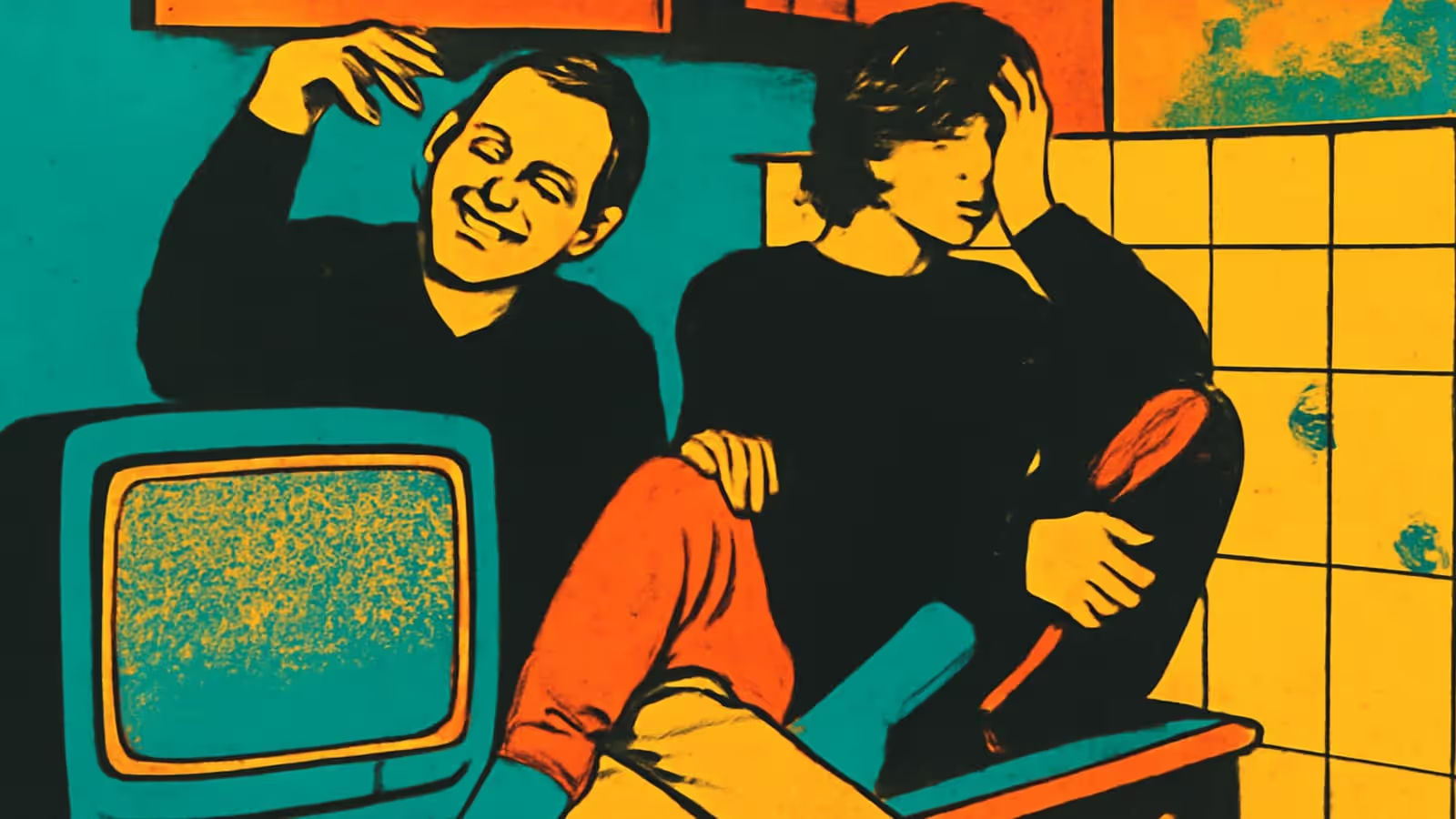
Camp Rock 3 was one of the more searched things in the United States this week, which is a fairly precise instrument for measuring how many people were teenagers around 2008. The interesting part is not the film. It is that nostalgia spent about three hundred years classified as a disease, and when researchers finally tested what it actually does, it turned out to be doing something useful.
Nostalgia was considered an illness
For roughly three centuries it was a medical diagnosis rather than an emotion. The term was coined in the seventeenth century to describe a condition observed in soldiers far from home, and it was treated as a neurological or psychiatric disorder, with proposed causes ranging from air pressure to brain lesions.
That framing survived into the twentieth century as a softer assumption, that dwelling on the past is inherently regressive. What is striking in hindsight is that nobody tested it. The systematic experimental work is recent, and it largely inverted the conclusion.
What it actually does
Inducing nostalgia in controlled conditions reliably raises reported social connectedness, self-esteem and sense of meaning. [wildschut-nostalgia] The method is straightforward: ask one group to recall a nostalgic event and another an ordinary one, then measure. The nostalgic group comes out higher on those dimensions afterwards.
The same research established what the memories are made of, which turns out to be the most useful practical detail. When people write out a nostalgic recollection, the recurring content is other people. Places, songs and smells show up as the route in rather than as the subject. This explains something that otherwise looks odd: a song from a particular year can trigger it powerfully while the memory that arrives is not about music at all.
- Other people, and you among them 58%
- A specific shared occasion 24%
- Place, music or object as the trigger 18%
A schematic of the content described in this article, to show relative share rather than measured data.
The loneliness loop
The finding that reframes the whole subject is that loneliness triggers nostalgia, and nostalgia then reduces loneliness. [zhou-loneliness]
The mechanism, as far as the research describes it, is that nostalgia increases perceived social support rather than actual social contact. Recalling being among people restores the sense of being someone who belongs to others, and that sense is much of what loneliness removes. Loneliness is not simply a shortage of people; it is the felt gap between the connection you have and the connection you want, which is why it is possible to feel it in a full room.
So the sequence looks like a regulatory loop: connection drops, nostalgia is triggered, felt connection partly recovers. That is a very different account from the one implied by three centuries of treating it as pathological, and it suggests the correct response to catching yourself in it is not embarrassment.
The distinction that decides whether it helps
Whether it substitutes for contact or prompts it. This is the practical test, and unlike most such distinctions it is directly observable in your own behaviour.
The functional version is bittersweet and slightly outward-facing. It comes with a small increase in willingness to reach out, and it is often followed by actually messaging somebody from the memory. Researchers find nostalgia associated with greater optimism and greater intention to connect, and that forward-facing quality is the signature of the version that is doing its job.
The unhelpful version is closed. It ends with the present compared unfavourably to the past, no impulse to contact anybody, and a sense that the good part is finished. That state is closer to rumination than to nostalgia proper, and it shares rumination’s central feature: it circles the same material and produces nothing. [apa-loneliness] Our article on rumination covers that loop and how to interrupt it.
Which version is yours?
Think of the last time you spent an evening with old photographs, music or messages. Tick anything true of afterwards. This is a reflection prompt rather than a test, and it produces no diagnosis.
0 of 6 ticked
Several evenings in a row, ending further from people rather than closer, is the closed version and it behaves like rumination rather than like nostalgia. The intervention is small and specific: after it, send one message to one person in the memory. That converts the loop from a substitute for contact into a prompt for it.
Warmer towards people, bittersweet rather than bleak, some impulse to reach out. That is nostalgia doing what the research says it does, and the only thing worth adding is acting on the impulse while it is there rather than the following week.
Nothing here matched. If loneliness is the reason you are reading this, the screener below is a more direct place to start.
Using it deliberately
If it is a mechanism rather than an indulgence, it can be used on purpose. Three practical notes from what the research describes.
Go for the people, not the era. Nostalgia marketing sells the year: the soundtrack, the fashion, the packaging. What actually produces the effect is a specific occasion with specific people. A film from 2008 is a trigger; the memory worth staying with is who you watched it with.
Finish with a message. The single highest-value habit here is converting the impulse into one sent message. The research finding is about increased intention to connect, and intention decays quickly. One message, that evening.
Do not use it as the whole answer. Nostalgia raises the felt sense of connection, which is genuinely useful in a bad week and is not the same as having people. Our loneliness guide covers what closes the actual gap, and why making friends as an adult is so hard covers the mechanics of the harder part.
When to seek help
Speak to a doctor or a therapist if loneliness has been constant for months rather than passing, if you have withdrawn from people you used to see, or if you cannot identify anybody you could contact when something goes wrong. Persistent loneliness is a health issue rather than a social failing, and it responds to specific approaches rather than to being told to get out more.
Go sooner if the sense that the good part of your life is finished has become settled rather than occasional. That belief is a symptom worth treating, not a conclusion worth accepting.
Contact your local emergency services or a crisis helpline if you feel unsafe or have thoughts of harming yourself.
How MyFreud can help
MyFreud is a mobile app that helps you find solutions to problems that have affected your mind and productivity. Live coaching sessions give you somewhere to work out whether an evening spent in the past left you closer to people or further from them, each one ends with an actionable plan rather than a feeling, daily tracking shows whether contact is actually increasing, and the notepad is where the message you meant to send gets written before the impulse fades.
Download MyFreud and start today: App Store or Google Play.