
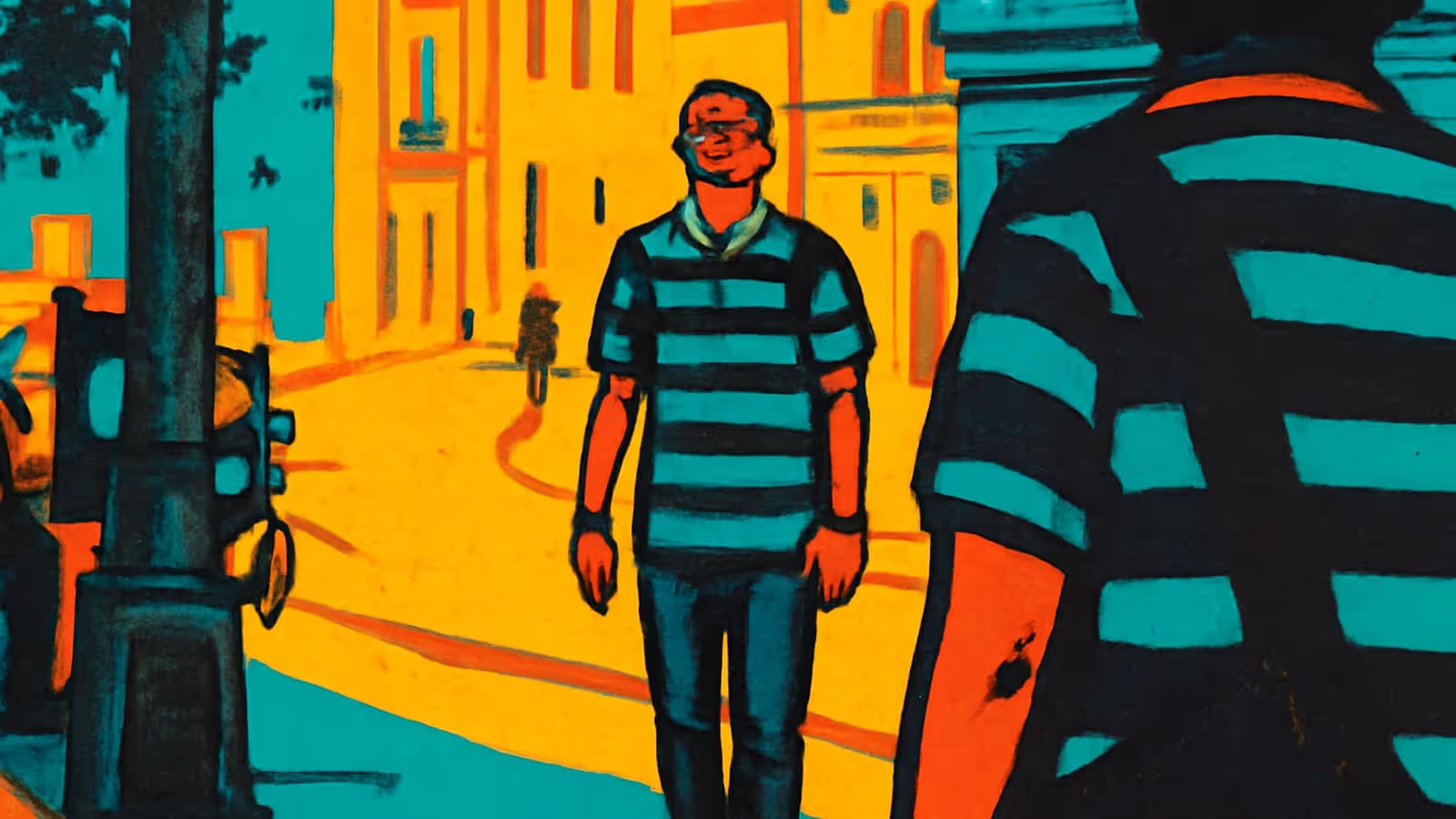
Hypervigilance is a raised state of threat detection that stays switched on when there is nothing to detect. It is a setting rather than a personality trait or a choice, which is the single most useful thing anybody can tell you about it, because a setting is something that can be adjusted and a personality is supposed to be who you are.
Most people arrive at this word wanting to settle one question: does having it mean they have PTSD. The honest answer is no, not on its own.
What hypervigilance actually is
It is a threshold problem rather than a volume problem. Everybody runs a threat-detection system that reads faces, sounds and movement in the background and decides what deserves attention; in hypervigilance that system is set to flag things that do not warrant flagging, so the output is not louder so much as wrong about what counts.
Two distinctions are worth having early, because both get muddled.
It is not the same as being anxious in general. Anxiety is largely about the future and arrives as worry, prediction and dread. Hypervigilance is about the present and arrives as detection, before any thought has formed. You have already turned towards the noise by the time you have an opinion about it.
It is also not paranoia. Paranoia involves a belief about somebody’s intentions towards you, which can be examined and argued with. Hypervigilance is a sensitivity setting that fires before belief is involved at all, which is exactly why arguing with it does so little.
What it looks like day to day
It looks like a set of small behaviours that make complete sense one at a time and add up to something only when you list them. This is a word people recognise themselves in immediately and then struggle to describe, so here is the concrete version.
- Seating. Choosing the chair that faces the door, and noticing the discomfort when somebody else takes it first.
- Entering a room. Scanning it on the way in, counting the people, registering the exits, without ever deciding to.
- Reading faces. Checking expressions for irritation, and finding it in people who are merely tired or concentrating.
- Startle. A dropped plate, a slammed door or someone arriving behind you producing a jolt out of proportion to the sound. [apa-ptsd]
- Tracking. At a gathering, always roughly knowing where certain people are and what mood they are in.
- Night. Waking at small noises, or lying awake listening to the house settle.
None of these is strange in isolation. Most of them are what a competent person does somewhere genuinely unsafe. The problem is the setting persisting after the situation ended.
A schematic of the threshold difference described in this article, not measured data.
The raised voice moves in both views, which is the point: a hypervigilant system is not broken, it is correctly ranking a raised voice above a closing door. What has changed is where the floor sits. The bar that matters most is the neutral face, because a face doing nothing is the clearest case of the system reporting something that is not there.
Does hypervigilance mean I have PTSD?
No, not on its own. Hypervigilance is one symptom, and it sits under the criterion covering marked alterations in arousal and reactivity, alongside exaggerated startle, irritability, difficulty concentrating and disturbed sleep. A diagnosis of post-traumatic stress disorder requires symptoms across several separate groups, persisting beyond a month, and causing significant distress or a real impairment in how you function. [apa-what-is-ptsd]
The range of people who have it is much wider than the diagnosis, and this is the part that usually settles the question:
- Anxiety disorders. Threat scanning is a standard feature, though the threat being scanned for is often social. Someone with social anxiety reads a room for disapproval with exactly the same machinery.
- Complex trauma. Where the harm was prolonged and hard to escape rather than a single event, hypervigilance is one of the most consistent leftovers. Our guide to complex PTSD and why only one diagnostic manual recognises it covers how that picture is described and contested.
- No diagnosis at all. People who spent years somewhere unpredictable and now scan rooms out of habit. A volatile household, an unsafe neighbourhood, a physically risky job, or caring for somebody whose mood set the temperature of every room.
That last group is large and rarely mentioned, and it is worth stating plainly: prolonged unpredictability is enough. There does not need to have been an identifiable frightening event with a date on it. If you want the wider picture of how trauma is defined and treated, our guide to trauma and PTSD is the place to start.
Do you recognise this?
Tick anything true. This is a reflection prompt rather than a test, and it produces no diagnosis.
0 of 6 ticked
Several of these together describe a threshold set lower than your current situation calls for. It is a common thing to live with and it responds to treatment, which is more than can be said for most things people quietly assume are just their character. The most useful thing to bring to a first appointment is the specific behaviours rather than the word, because scanning rooms and waking at noises get taken seriously in a way that "I am on edge" often does not.
Tiredness that sleeping does not fix, and startling at ordinary sounds, are the two items that most reliably indicate arousal rather than ordinary stress. Sleep is also the one you can act on first, and it is genuinely worth acting on, because short sleep pushes the threshold down further and makes everything else on this list stronger.
Nothing here matched, which is worth knowing if you were reading this about somebody else. The most useful thing to understand from their side is that the reactions are not chosen and were not invented, and that being told there is nothing to worry about lands as being told you are wrong about what you just saw.
We have no screener for trauma. The free screener above is the GAD-7, which measures generalised anxiety, and anxiety and hypervigilance overlap in the arousal symptoms without being the same thing, so treat the result as a rough reading of one neighbouring problem rather than an answer about trauma. Nothing on this site screens for PTSD, and a proper assessment is a clinical conversation rather than a questionnaire anyway.
Why it is so exhausting
Because monitoring for threat costs something continuously, and it does not stop when you sit down. The exhaustion is the part almost everybody underestimates, including the person living with it, who tends to attribute the tiredness to something else entirely.
Attention is finite. If a meaningful share of it is permanently allocated to scanning faces, tracking positions and evaluating sounds that most people filter out before ever noticing them, there is less of it left for work, conversation and everything you actually wanted to spend the day on. That is the whole mechanism. It is not mysterious, and it explains why hypervigilance so reliably arrives alongside poor sleep, irritability and a fog that reads as low mood.
Then it loops. Sleep is the first casualty, because a system watching for danger does not power down on cue, and short sleep appears to increase how strongly the brain responds to negative material while weakening the prefrontal regulation that usually damps it down. [yoo-sleep] Note what that study did not establish: it looked at healthy young adults after a single night of total sleep deprivation, not at people with hypervigilance, and it does not show that fixing sleep fixes the threshold. What it supports is the narrower and still useful claim that being short of sleep makes the reaction bigger, which is enough reason to treat sleep as a lever rather than an afterthought.
The social cost nobody warns you about
Threat reads that feel completely accurate produce reactions that other people experience as disproportionate. This is the part that damages relationships, and it is almost never described accurately by either side.
From the inside, the sequence is coherent. A face changed, a tone flattened, something was clearly wrong, and you responded to it. From the outside, somebody snapped at nothing. Both accounts are honest. The disagreement is not about behaviour, it is about what was in the room, and that is an unusually hard argument to resolve because neither person can show the other their evidence.
Two things follow, and they are worth naming because they compound. The person with the lower threshold starts to distrust their own reading of every situation, including the ones where they were right, which is its own kind of erosion. And the people around them start managing their tone, which produces exactly the flat, careful, slightly unnatural manner that the scanning was watching out for in the first place.
The useful move here is not to litigate who was right. It is to say what happened out loud, early, in a form that does not require a verdict. Something along the lines of: your voice went flat and I read it as anger, so tell me what it actually was. That takes the read out of the argument and puts it on the table, which is where it can be checked.
It was almost always correct once
A system that learned to scan a room learned it somewhere that scanning rooms was the right thing to do. This is the reframe that helps more than any technique, and it is not a comforting story told to soften the problem; it is an accurate account of where the setting came from.
Calling hypervigilance irrational is both wrong and useless. Wrong, because the response was proportionate to the environment that trained it, and someone who grew up reading a parent’s footsteps on the stairs was reading them accurately. Useless, because a system built by repeated experience does not update on being told it is being silly, and the person has usually told themselves that a thousand times already without effect.
The same logic applies to the other things a threat system does under pressure, including the one people are most ashamed of. Our article on the freeze response and why you could not move or speak covers a reaction that is similarly automatic and similarly misread afterwards as a failure of character.
The environment that did the training is not always a household. Repeated discrimination is a chronic exposure with the same structure, and our guide to what racial trauma does to a threat system covers why the individually small incidents are the ones that keep the setting high.
What makes hypervigilance a problem now is context, not capacity. The setting is running somewhere that no longer requires it. And that is why the treatment target is the threshold rather than the capacity: nobody is trying to remove your ability to notice danger, which is worth having and which you would want back in an instant if the situation changed. The work is on where the floor sits.
What actually helps
The treatments with the strongest evidence for post-traumatic stress disorder are trauma-focused cognitive behavioural therapy and eye movement desensitisation and reprocessing, usually called EMDR. [who-stress] Both are named therapies with protocols, which means you can ask for them by name, and asking by name shortens the conversation considerably compared with asking for help with feeling on edge.
Three things are worth knowing before you go.
Sleep is a real target, not preparation for the real work. Short sleep lowers the threshold further, so a period of protected sleep frequently produces a visible drop in reactivity before any trauma work has started. If you can only change one thing this month, change that one. Our guide to grounding techniques for anxiety includes the ones designed for the middle of the night, when the ordinary advice is useless because you cannot get up and move around.
Grounding manages an episode, it does not change the setting. This distinction is often left out, and leaving it out sets people up to conclude that treatment failed when what actually happened is that a rescue technique did exactly what a rescue technique does. Grounding brings down an activation already underway, reliably and quickly, and it is genuinely worth having. It does not lower the floor. Trauma-focused therapy is what works on the floor.
Where there is no diagnosis, an assessment comes before a technique. Hypervigilance appearing on its own points in several directions at once, and the treatment differs depending on which. Someone scanning for social disapproval and someone scanning for physical danger need different work, and neither is helped by a technique chosen from the wrong list.
When to seek help
Speak to a doctor or a therapist if scanning, startling or reading faces for threat has been going on for months, and describe the specific behaviours rather than the word: sitting where you can see the door, waking at small noises, jumping at a dropped plate. Concrete behaviour gets an assessment, and “I am on edge” tends to get advice about relaxing.
Go sooner if you are not sleeping, if it has started costing you a relationship or a job, if you are drinking to bring the level down in the evenings, or if avoiding places and people has narrowed your life to keep the reactions manageable. Ask specifically whether trauma-focused CBT or EMDR is available to you, and say if something happened, even if you are not sure it counts.
Contact your local emergency services or a crisis helpline if you feel unsafe or have thoughts of harming yourself.
How MyFreud can help
MyFreud is a mobile app that helps you find solutions to problems that have affected your mind and productivity. Live coaching sessions give you somewhere to describe the reads that other people dismissed, which is usually the material that never makes it into an appointment, and each one ends with an actionable plan rather than reassurance that nothing is wrong. Daily tracking shows startle and irritability against how much you slept, which is the loop this article describes and the hardest one to see from inside it. The notepad is where you write down what actually happened in the room, close to the time, so the question of what was there can be checked later rather than argued about.
Download MyFreud and start today: App Store or Google Play.