
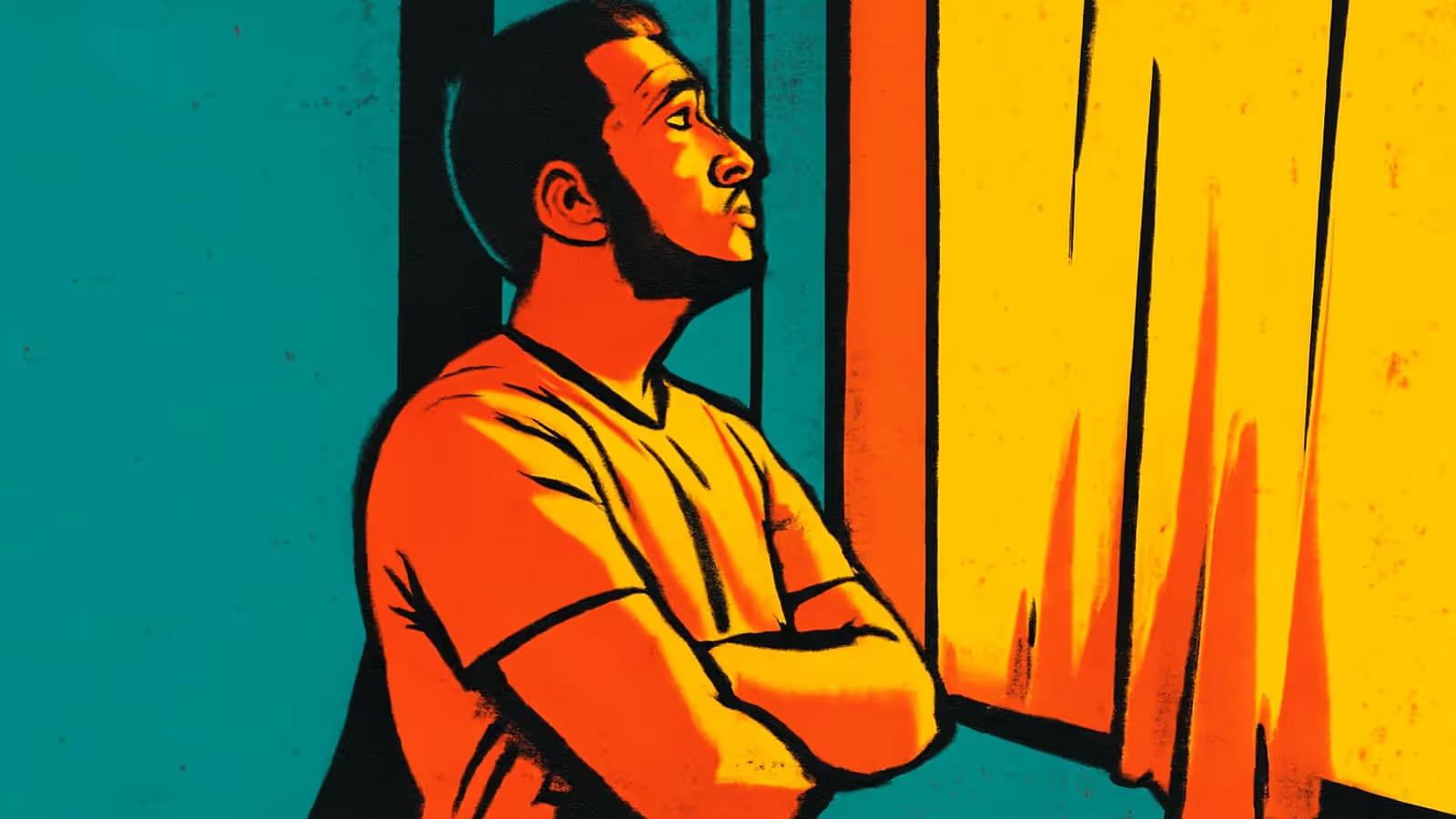
Talking about a trauma does help, but the version that helps is not the version most people picture. A structured course of therapy, started once the dust has settled and delivered by someone trained in it, has good evidence behind it. A single emotional debrief in the first days afterwards does not, and the research on that format is unusually clear.
This matters because the instinct to get someone talking straight away is a kind one, and for decades it was formal practice after disasters, accidents and violent incidents. It turned out not to work.
The one-off debrief does not prevent PTSD
Psychological debriefing was a single session, usually within a few days of the event, in which people were taken back through what happened and encouraged to express how they felt. It was widely used, often provided to whole groups of workers at once, and sometimes mandatory.
A Cochrane review pooled the trials of that format and found no evidence it prevented post-traumatic stress disorder. People who received it reported no reduction in PTSD severity at one to four months, at six to thirteen months, or at three years, and no reduction in general psychological distress, depression or anxiety either. The authors went further than a null result and concluded that compulsory debriefing of trauma victims should cease. [rose-2002-debriefing]
NICE guidance followed the evidence. NICE recommends that psychologically-focused debriefing is not offered for either the prevention or the treatment of PTSD. [nice-2018-ptsd]
The likely reason is not that talking is harmful in itself. It is that a one-off session reactivates a memory at its rawest, in a person whose arousal is already high, and then ends. There is no second appointment in which anything gets processed. The structure that makes therapy work is missing, and only the difficult part is left.
Most people recover without treatment
The second thing the early-intervention research changed is the assumption that distress in the first weeks predicts a lasting problem. Usually it does not.
Intrusive memories, broken sleep, jumpiness and a strong urge to avoid reminders are common in the days after something frightening, and in most people they fade over the following weeks. That is why guidance sets the threshold for formal trauma-focused therapy at presentations more than a month after the event, with active monitoring rather than immediate treatment for milder symptoms before that point. [nice-2018-ptsd]
An illustration of the pattern described in NICE guideline NG116, which sets the threshold for trauma-focused therapy at more than one month after the event because most early distress resolves. Not measured data.
The practical consequence is that feeling terrible in week one tells you very little. What carries information is whether the line is still flat at week six.
What the evidence actually supports
For people whose symptoms persist, the recommended treatments are specific, and both of them involve the memory rather than working around it.
NICE recommends offering an individual trauma-focused cognitive behavioural therapy to adults presenting more than a month after a traumatic event, typically over eight to twelve sessions and more where clinically indicated. It should include education about reactions to trauma, strategies for managing arousal and flashbacks, safety planning, and processing of the trauma memory and the emotions attached to it. EMDR is recommended as an option to consider for adults. [nice-2018-ptsd]
Notice what those have in common with each other and not with debriefing. They are courses rather than events. They build regulation skills before they go near the worst of the memory. They are paced by someone who can tell when to slow down. The talking is a tool inside a structure, not the treatment on its own.
Is not wanting to talk a bad sign?
Avoidance is one of the recognised features of trauma responses, so the reluctance is part of the thing itself rather than a character failing. In the early weeks it is often protective.
It earns attention when it starts shaping the rest of your life. The question worth asking is not “have I talked about it” but “how much am I rearranging to avoid being reminded”.
Is it worth taking to someone?
Tick anything that has been true for most of the past month, more than a month after the event.
0 of 6 ticked
Several of these persisting past a month is the pattern that guidance says should prompt an assessment. A doctor is the usual first step.
One or two of these, a month or more after the event, are common. Worth watching whether they are settling or staying flat.
Nothing on this list stood out. If something still feels wrong, that is reason enough to talk to someone.
This is a prompt for reflection, not a test or an assessment of any kind. No validated trauma screener is published on this site yet, so the link above goes to the assessments we do have.
What to expect if you do seek help
A first appointment is usually about working out what has been happening and how much it is affecting you, not about recounting the event. Trauma-focused therapy that follows tends to spend its early sessions on understanding your reactions and building ways to manage them, and only then turns to the memory itself.
If you are offered a single session with no follow-up and are asked to describe everything in detail, it is reasonable to ask what happens next. That format is the one the evidence argues against.
You can read more about how trauma presents and how it is treated in our guide to trauma and PTSD, and our guide to the freeze response answers the question that most often goes unasked: why you could not move. If a service has described itself to you as trauma-informed, our guide to what trauma-informed therapy is and is not explains why that phrase does not tell you which treatment you are being offered.
When to seek help
Speak to a doctor if symptoms are still there a month after the event, if they are getting worse rather than better at any point, or if they are interfering with work, study, sleep or relationships. Do not wait out the month if the distress is severe.
If you are in immediate danger, or thinking about harming yourself, contact your local emergency services or a crisis line in your own country now.
How MyFreud can help
MyFreud is not therapy and does not treat PTSD. What it does do is daily mood tracking that shows the pattern over weeks, which is exactly the information the month-after question turns on. Noting how you slept, how often the memory intruded and what you avoided gives you something concrete to bring to a doctor, instead of trying to reconstruct six weeks from memory in a ten-minute appointment.
Download MyFreud and start today: App Store or Google Play.