
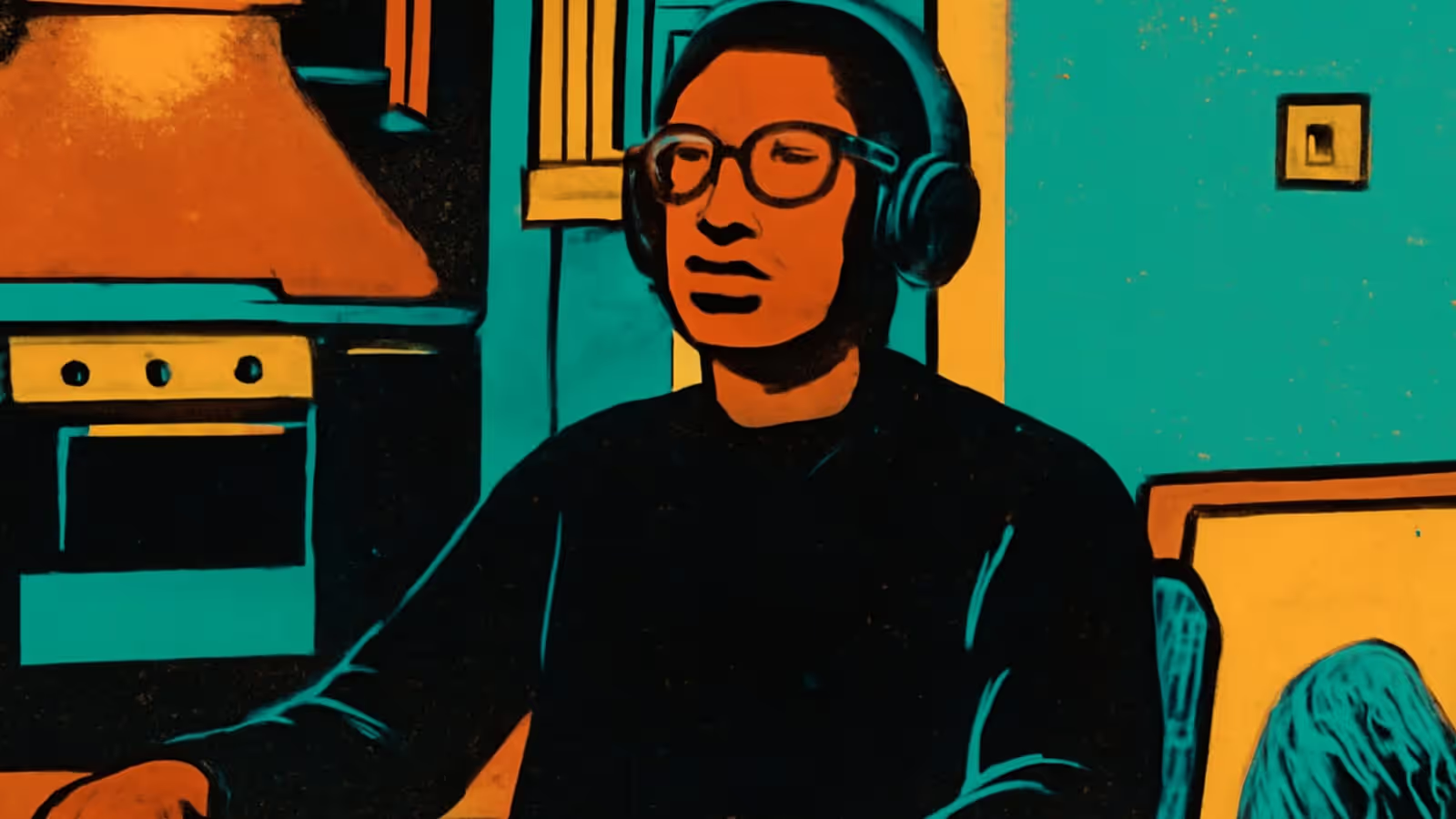
Autism is a difference in how sensation, information and social signals are processed, present from early development and lasting across life. [lai-2014-autism] It is not an illness and it is not something that arrives, which is why an adult recognising it in themselves is not discovering a new problem so much as finding the frame that explains an old one. This guide is written for that reader: what autism actually involves, why so many adults were missed, and what helps.
What autism actually involves
Two areas define it. The first is social communication: reading implication rather than words, managing the unwritten rules of conversation, and the effort involved in doing what other people appear to do automatically. The second is a pattern of focused interests, a preference for predictability, and sensory processing that differs in either direction from most people’s.
The sensory half is the part routinely left out of popular descriptions, and it is often the most immediately disabling. Sound that is background to everyone else is foreground. Lighting is genuinely painful. Textures of clothing or food are not a preference. None of this is visible from outside, which is part of why the accommodations that help most look trivial to people who do not need them.
The word spectrum is widely misread as a line from mild to severe. It is better understood as a profile: support needs differ across areas within one person, and someone with almost no support needs in one domain may have substantial ones in another.
Why so many adults were missed
The criteria were built largely on observations of boys, and the case descriptions that trained a generation of clinicians came from the same source. A presentation that involved copying others closely, having interests that looked socially conventional, and turning difficulty inward rather than outward was systematically less likely to be recognised.
Hull and colleagues describe this pattern as a female autism phenotype, while noting it is not exclusive to women. [hull-2020-phenotype] The practical result was perverse: being articulate, academically successful or outwardly compliant made diagnosis less likely without making autism less likely.
Most late recognition happens by one of three routes. A child or sibling is assessed and the criteria describe the parent too. Or the person reads a first-hand account and finds it describes an inner experience they assumed was universal. Or the strategies stop working, usually after a period of sustained overload.
Masking, and what it costs
Masking is the effortful suppression of natural responses in order to appear non-autistic, and it explains more about late diagnosis than anything else, particularly for the group it is most studied in: our guide to autism in women and girls covers why the diagnostic picture missed them. Rehearsing conversations, forcing eye contact that is uncomfortable, copying expressions, and suppressing the repetitive movements that actually regulate you are all versions of it.
It is usually not a decision. It is learned early, often because being visibly different drew exclusion or punishment, and it becomes automatic enough that the person cannot always tell when they are doing it. Cage and Troxell-Whitman found it associated with exhaustion and with poorer mental health outcomes. [cage-2019-camouflaging] Our guide to autism masking covers what the research since then has found it linked to, and what it does not yet prove.
This is the mechanism behind an experience many autistic adults describe and few employers understand: functioning entirely normally through a working day, then being unable to speak, cook or answer a message for hours afterwards. Our article on autistic burnout covers what happens when that runs for years rather than a day.
What actually helps
| Area | What helps | What usually does not |
|---|---|---|
| Sensory | Noise-cancelling headphones, controlling lighting, choosing seats and times deliberately | Being told to get used to it |
| Demand load | Fewer transitions, advance notice of change, recovery time after social demand | Filling recovery time with something restful but still demanding |
| Communication | Asking for things in writing, saying plainly what you need, dropping the reading of implication | Guessing, then apologising for having guessed wrong |
| Work | Written instructions, predictable schedule, a quiet space, adjustments requested formally | Hoping a good manager will notice |
| Mental health | Treating the anxiety or depression, and reducing the demands producing them | Treating the anxiety while the demands stay identical |
The pattern across that table is that the effective adjustments are cheap, specific and environmental, while the ineffective ones ask the autistic person to absorb the difference privately. That is the same asymmetry the masking research describes.
Things late-diagnosed adults commonly recognise
This is not a screening test and it cannot tell you whether you are autistic. It lists experiences that come up repeatedly in accounts from adults diagnosed late.
0 of 6 ticked
Recognising most of this list is a reason to read first-hand accounts by late-diagnosed adults and, if it keeps fitting, to ask a doctor about assessment. It is not a diagnosis.
Several of these are common in the general population too. What tends to distinguish an autistic profile is the number of areas involved and that it has been lifelong rather than recent.
Little of this is familiar. If something else is difficult, that is worth raising with a doctor on its own terms.
No validated autism screener is published on this site. If anxiety or low mood is the more pressing problem, the hub has instruments for those.
The mental health that comes with it
Anxiety and depression occur at high rates alongside autism, and they are usually what brings an adult to a doctor first. Treating them is worthwhile and works. It works less well when the autism goes unrecognised, because the demands generating the distress carry on unchanged, and the person is left concluding that treatment does not work for them.
This is the practical argument for recognition even where a formal diagnosis is not pursued. Knowing that a working week is expensive for reasons that are structural rather than personal changes what you do about it, and it changes what you ask for. Our guides to anxiety, depression and ADHD in adults cover the conditions that most often accompany it, ADHD frequently enough that assessment usually considers both. Where both are present the two sets of needs actively conflict, which is its own problem: what happens when autism and ADHD occur together covers why advice written for one can make the other worse.
When to speak to someone
Speak to a doctor if low mood or anxiety has lasted more than a couple of weeks, if you are exhausted in a way that rest does not resolve, or if you have withdrawn from things you used to manage. Those are worth treating whether or not autism turns out to be part of the picture.
If you want to raise assessment, bring specifics from across your life rather than recent difficulties: what school was like, what you were told about yourself as a child, which situations have always been costly. Adult assessment relies heavily on developmental history, and arriving with it saves time in a system where waits are often long. One area worth being specific about is sensory overload, which is part of the diagnostic criteria and is routinely under-reported because people have stopped noticing how much they organise around it.
How MyFreud can help
Recovery time after social or sensory demand is the pattern most autistic adults underestimate, because the cost lands hours later and gets attributed to something else. Tracking mood daily makes the lag visible, which is what turns a vague sense of being drained into something you can plan around.