
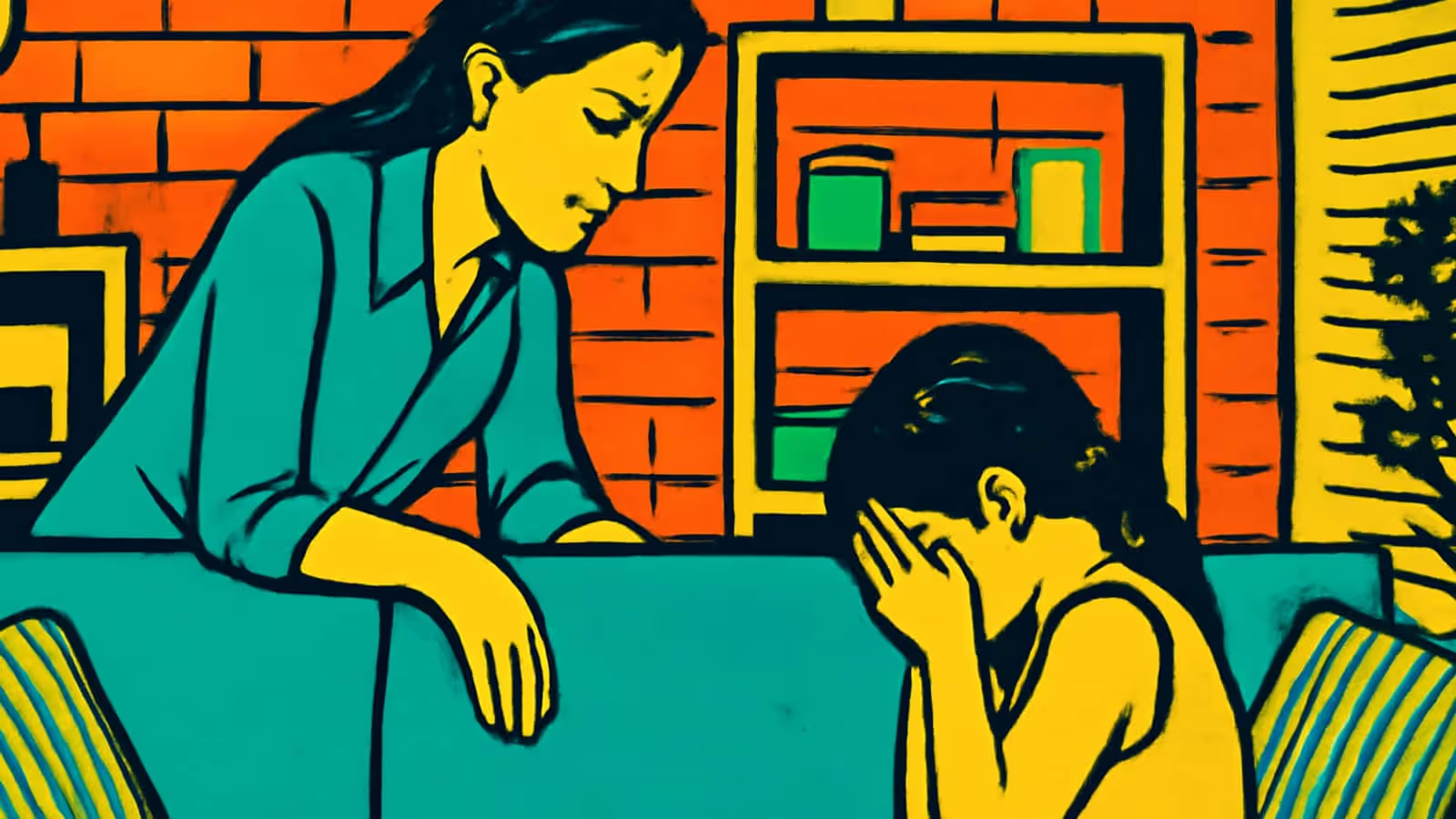
ODD stands for oppositional defiant disorder, and the question that separates it from ADHD is not whether a child refuses but whether they could have complied. ADHD produces non-compliance as a side effect of inattention and impulsivity; ODD produces it on purpose.
From across a room the two look the same, which is why they are confused constantly and why the confusion changes what a household does for years.
What ODD actually is
A persistent pattern rather than a set of incidents. The diagnostic description covers angry or irritable mood, argumentative and defiant behaviour, and vindictiveness, present for at least six months, occurring more often than is typical for the child’s age, and causing problems at home, at school or with peers. [dsm-odd]
Two things in that are load-bearing and routinely skipped. Six months, which rules out a reaction to a bereavement, a move, a new school or a difficult term. And more than is typical for the age, which matters enormously, because arguing with adults is normal childhood behaviour at some rate, and toddlers and teenagers both have developmental phases where refusal is the job. The diagnosis is a claim about frequency and cost, not about whether refusal ever happens.
The question that separates them
Could they have done it? That is the distinction underneath everything else, even though it is not directly observable.
With ADHD, the failure is upstream of the choice. The instruction was given from another room and never registered. The task was started, and then something else was more interesting. The rule was known and the impulse arrived first. Ask an hour later and the child frequently agrees with the rule and cannot explain what happened, and that bafflement is real rather than performed.
With ODD, the instruction landed and is being refused, and the refusal itself is the object. Asking later produces a justification rather than confusion.
Since you cannot see inside the moment, use the proxy that works: where does it happen.
- With one or two specific adults 58%
- At home generally 27%
- At school and with peers 15%
A schematic of the pattern described in this article, drawn to show relative share rather than measured data.
ADHD difficulties do not distribute like that. They show up with everybody, in every setting, including with adults the child likes and in activities they enjoy, which is why an assessment requires evidence from more than one place. Oppositional behaviour that appears only with one parent and disappears entirely at school is telling you something about a relationship rather than about a brain.
Why they travel together so often
Because one plausibly produces the other. A large share of children with ADHD also meet criteria for ODD, considerably more than chance would give you, and the sequence in the history is usually informative.
Consider what several years of undiagnosed ADHD looks like from inside. You are told off many times a day, for things you genuinely did, that you did not intend and cannot reliably stop. Adults are consistently disappointed. You are described as lazy, careless, or as not trying, by people who are not being cruel and are simply reading the evidence available to them. Somewhere in that, a reasonable child concludes that compliance does not work and that the relationship is adversarial, and starts behaving accordingly.
That is not the only route and it is not proven as a mechanism, but it fits what clinicians see, and it has a practical consequence: treat the ADHD first and a good deal of the opposition often subsides, because the friction that was generating it drops. Where medication is part of the picture, guidance sets out how it is sequenced alongside behavioural support rather than instead of it. [nice-ng87-odd]
What actually helps
The intervention with the best evidence is a parent-focused behavioural programme, and the meta-analytic picture is worth stating precisely because it is often oversold. When outcomes were rated by people who probably did not know which group a child was in, improvements held up for parenting and for children’s conduct problems, while effects on core ADHD symptoms did not reach significance. [daley-odd]
Read that carefully, because it is unusually good news for this specific question. The thing these programmes most reliably improve is exactly the thing ODD consists of.
The mechanics that do the work:
- Instructions delivered at close range, one at a time, with eye contact. A large share of what gets recorded as defiance is an instruction that never arrived.
- Immediate, small, certain consequences. Delayed and large is the combination that fails, and it describes most household discipline.
- A deliberately reversed praise ratio. Children in this position hear far more correction than praise, which is how they build an account of themselves as the difficult one.
- One daily block of child-led time with no correction in it. The least appealing item on the list and the one that changes the relationship.
Our guide to parenting a child with ADHD covers those in full, and ADHD in children covers what an assessment involves. Where the flashpoint is a fast emotional escalation rather than a standoff, ADHD meltdown vs autism meltdown covers the difference, and the ADHD guide covers the wider picture.
The trap of the “he can do it when he wants to” argument
This sentence is said in nearly every one of these households, it is factually accurate, and it is almost always used to draw the wrong conclusion.
A child with ADHD really can concentrate for four hours on something absorbing and really cannot concentrate for six minutes on something that is not, and to an adult watching, the first observation looks like proof that the second is a choice. It is not. Attention in ADHD is not absent, it is poorly regulated, which means it is available in abundance when interest or urgency supply the drive and unavailable when they do not. The inconsistency is the condition rather than evidence against it.
The same sentence gets used about ODD from the opposite direction, where a child who behaves impeccably at school is assumed to be choosing to behave badly at home. That reading is closer to correct and still incomplete, because the more common explanation is that school holds a level of structure and consequence the home cannot reproduce, and that the child has spent the entire day using their capacity up there and has none left at four o’clock.
The practical move is the same in both cases: stop treating the good hours as the baseline the bad hours should be measured against. Ask what was different about the conditions instead, because the conditions are the part you can change.
When to seek help
Speak to a doctor if the pattern has lasted more than six months, if it is causing problems in more than one setting, if school has raised it, or if family life is being organised around avoiding conflict. Say which of the two shapes you are seeing and give examples from more than one place, because that spread is the detail a clinician will use.
Ask about a parent behavioural programme by name, and ask whether an ADHD assessment is warranted alongside it, since the combination is common enough that assessing for one without considering the other misses a great deal. Go sooner if there is aggression that is injuring somebody, if the child is being excluded from school, or if your own mood has dropped under the strain, which is common in these households and is treatable in its own right.
Contact your local emergency services or a crisis helpline if you feel unsafe or have thoughts of harming yourself.
How MyFreud can help
MyFreud is a mobile app that helps you find solutions to problems that have affected your mind and productivity. Daily tracking settles the question this article turns on, because it records where and with whom the behaviour actually happens rather than the version anybody reconstructs after a bad evening. Live coaching sessions are for the adult rather than the child, which is the part usually left uncovered, and each one ends with an actionable plan rather than reassurance. The notepad is where the examples from more than one setting go, since that is precisely what an assessment runs on and precisely what nobody can recall on the day.
Download MyFreud and start today: App Store or Google Play.