
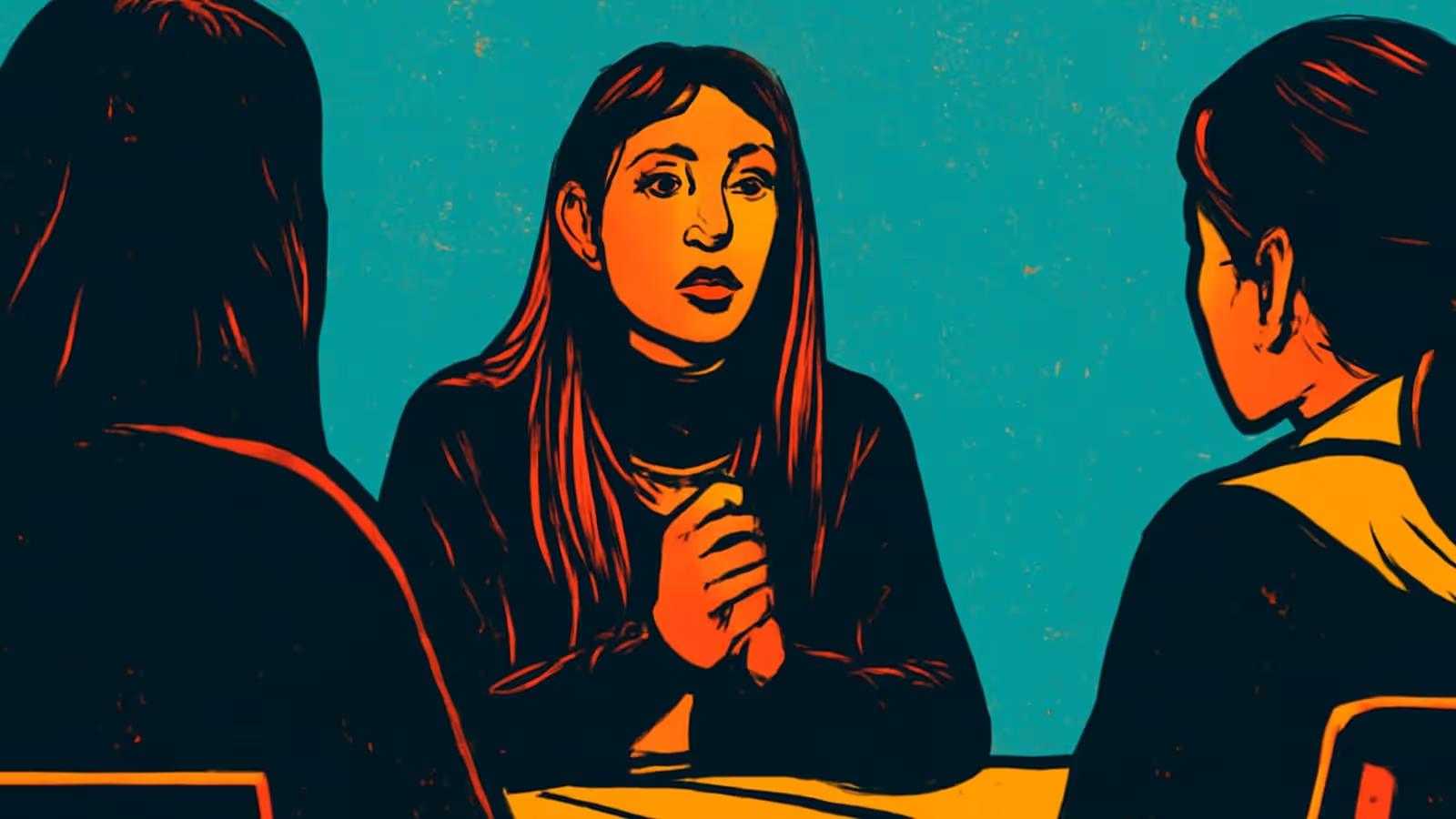
Cognitive behavioural therapy for social anxiety works by dropping the things you do to feel safer, then finding out what happens without them. It is not about replacing negative thoughts with positive ones, and a course that spends its time on that is unlikely to be the treatment with the evidence behind it.
That surprises most people who arrive expecting to be taught confidence. The intervention is closer to running a series of small experiments in which you deliberately give up your protections, which is uncomfortable by design and is where the change comes from.
How CBT for social anxiety works
It targets a loop in which attention turns inward and never gets corrected. The dominant cognitive account holds that when a socially anxious person enters a feared situation, attention shifts onto the self, and they construct an impression of how they appear using internal information: the felt heat in the face, the shake in the hands, the sense of the words coming out wrong. [clark-wells-1995-model] That impression is then treated as evidence of how they actually looked.
The problem is that felt sensations are a poor guide to appearance. Anxiety is far less visible than it feels, so an impression built from sensation systematically overstates it. Treatment interrupts the loop at three points: where attention goes, what you do to feel safe, and what evidence you accept about how it went.
What safety behaviours are, and why they are the target
Safety behaviours are the small precautions you take to reduce the chance of humiliation, and they are the main thing keeping the fear alive. Rehearsing a sentence before saying it. Gripping a glass with both hands so a tremor does not show. Sitting at the edge. Saying less. Mentally monitoring how you are coming across while somebody is talking to you.
They are the target because they make disconfirmation impossible. If an evening goes fine and you spent it rehearsing every sentence, the mind draws the obvious conclusion: it went fine because you rehearsed. The fear is never tested, so it never updates, and each successful evening quietly strengthens the belief that the precaution was necessary.
A schematic of the disconfirmation mechanism described in this section and in the cognitive model cited. Not measured data.
Anxiety in the moment is often slightly higher without the safety behaviour, which is exactly why this is hard, and it is the trade the treatment asks you to make.
What the evidence says
Individual CBT came out ahead of every other treatment in the largest comparison of options for social anxiety disorder in adults. A network meta-analysis pooling psychological and pharmacological interventions found individual cognitive behavioural therapy the most effective intervention compared, ranking above group CBT, other psychological therapies and medication. [mayowilson-2014-sad-nma]
Two caveats belong with that. It is a comparison of averages across trials, so it describes what is most likely to work rather than what will work for you, and medication remains a reasonable option, particularly where access to a proper course of therapy is the binding constraint. And a network meta-analysis of this kind draws on indirect comparisons, which is a genuine methodological debate rather than a settled matter.
What actually happens in the sessions
Roughly 14 to 16 sessions, most of them built around an experiment you agreed the week before. A typical arc runs like this. Early sessions map your own version of the loop: what you predict will happen, what you do to prevent it, and where your attention goes. Then the experiments start, and each one has a specific prediction attached, because a vague prediction cannot be disproved.
Two techniques tend to be the memorable ones. Attention training asks you to deliberately move attention outward during a conversation, onto the other person and the room, rather than onto your own sensations. It sounds trivial and is difficult, because the pull inward is automatic.
Video feedback is the one people dread. You are recorded doing something socially demanding, you predict in detail how visible your anxiety will be, and then you watch it. The gap between the predicted recording and the actual one is usually large, and seeing it does something that being told it does not. Our guide to safety behaviours covers the mechanism in more detail, and social anxiety versus introversion is worth reading first if you are unsure the label fits. The social anxiety hub covers what the condition is and how it differs from ordinary shyness.
Which safety behaviours are you running?
Tick anything you do in social situations. This is a reflection prompt rather than a test, and it produces no diagnosis.
0 of 7 ticked
Each of these is a precaution that prevents your fear from being tested, which is why they are the target rather than incidental detail. Take this list to a first appointment: naming the specific behaviours moves a session forward faster than describing the anxiety in general, and it is the information a therapist needs to design the first experiment.
Most people do some of these occasionally. What distinguishes social anxiety is doing them consistently, and feeling that an event would have gone badly without them. If that describes you, the anxiety screener below uses GAD-7, which measures general anxiety rather than social anxiety specifically, but is a reasonable place to start.
Nothing here matched. If social situations are difficult but none of these fit, the difficulty may be about preference and energy rather than fear, which is a different thing and is covered in our guide to social anxiety versus introversion.
When to seek help
Speak to a doctor or a therapist if fear of social situations has lasted more than six months, if you are avoiding work, study or opportunities because of it, or if you are using alcohol to get through social events. That last one is common and is worth naming directly, because it changes what treatment should address first.
Ask for cognitive behavioural therapy for social anxiety specifically, and ask which protocol the therapist uses. A generic anxiety course, or counselling in general, is not the treatment that carries the evidence above. Where you are offered a group programme and would prefer individual work, it is reasonable to say so and to say why.
Go urgently if you have thoughts of harming yourself.
How MyFreud can help
Social anxiety is easiest to underestimate in retrospect, because the events you avoided leave no trace and the ones you attended get remembered as fine. MyFreud gives you daily mood tracking that shows the pattern across weeks, so you can see what you actually did and how it actually went, rather than reconstructing it later.
Download MyFreud and start today: App Store or Google Play.