
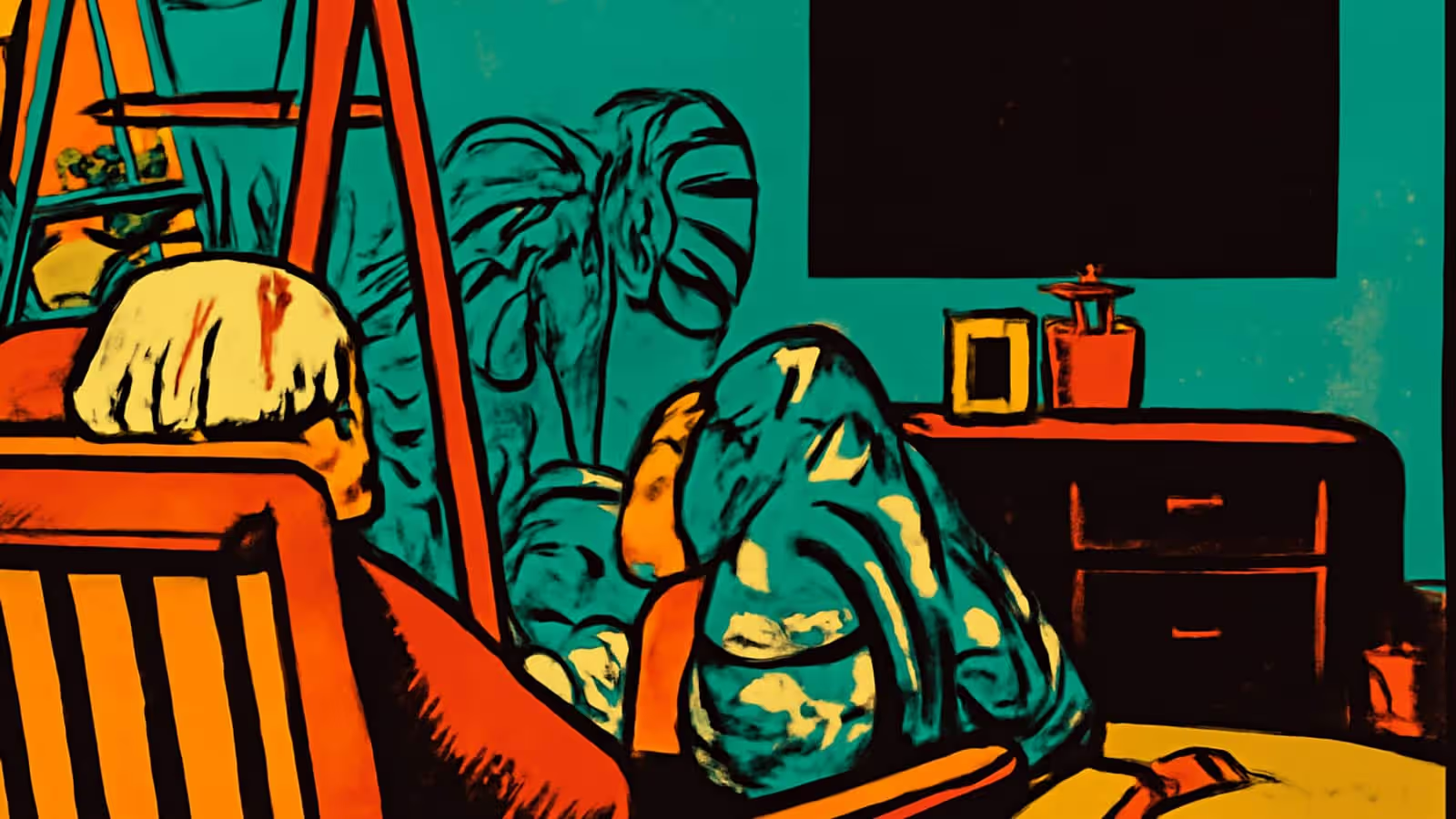
A television drama’s second season sent half a million people searching for it this week, and a predictable share of that traffic was not people looking for the release date. It was people looking for other people to talk to about characters they have been living alongside for a year. The reflex is to treat that as slightly embarrassing. It is more interesting than that: the bond is running on exactly the machinery you use for real relationships, which is why it produces real grief.
What a parasocial bond actually is
It is a one-sided relationship in which you know a great deal about somebody who does not know you exist. The term was coined in 1956 by two sociologists describing how television audiences related to broadcasters, and it was descriptive rather than pejorative from the start. [horton-wohl]
The thing worth understanding is that your social machinery cannot fully distinguish between a face you see every week on a screen and a face you see every week in a room. It evolved in a world where the only way to repeatedly see someone’s face, hear their voice, and watch them react to things was to actually know them. Screens present that same evidence without the relationship behind it, and the machinery responds as designed.
Why fiction produces a stronger bond than real acquaintance
Because it gives you a kind of access no real person grants. You watch a character alone, hear their reasoning, see the version of them nobody in their world gets to see, and you do it without any of the social cost that real intimacy demands.
Consider what you know about a character you have followed for three seasons: their history, their private fears, the thing they will not admit, how they behave when nobody is watching. Now consider how much of that you know about a colleague you have sat near for the same three years. The asymmetry is not a failure on your part. It is what the form is built to manufacture, and it is manufactured rather than earned, which is precisely why it can feel deeper than relationships that actually are reciprocal. It also says nothing about your capacity for the reciprocal kind, which our relationships guide covers.
Serial television is unusually potent here because of duration. A film gives you two hours; a series returning across years gives you the repeated, spaced exposure that ordinary familiarity is built from.
- The characters themselves 44%
- The weekly structure and ritual 33%
- The community watching alongside you 23%
A schematic of the components described in this article, to show relative share rather than measured data.
Why the ending hurts
Because you lose three things simultaneously, and only one of them is fictional. Researchers who studied what happens when viewers’ favourite characters leave found reactions closely resembling the response to a real relationship ending, and gave it the obvious name: parasocial breakup. [eyal-cohen]
The three components are worth separating, because people usually attribute the whole feeling to the first one and then judge themselves for it:
- The characters, who you have known longer than you have known some of your friends.
- The structure, a reliable thing that arrived weekly and organised your evenings and your anticipation.
- The community, which is often the largest part and the least noticed. Ending a series frequently ends a group chat.
That last one explains why finales feel worse than they should. You are not only losing a story. You are losing the reason a set of people spoke to each other every week.
When it is worth examining
The question is not intensity but substitution. Caring a great deal about a character is not a problem in itself, and the research generally finds these bonds benign and sometimes protective, particularly for people who are isolated or socially anxious, where a reliable fictional world can be genuine relief rather than avoidance. [apa-relationships]
What changes the picture is when the fictional relationship starts doing the job of a real one:
- Declining real invitations in order to stay with the show, repeatedly rather than occasionally.
- Distress interfering with function, in your sleep, your work, or your ability to concentrate for more than a few days.
- Spending you cannot afford on merchandise, conventions or content.
- Believing the bond is mutual in a way that goes past enjoying it, particularly with real people such as streamers or performers, where the asymmetry can become genuinely painful.
The useful distinction is between a relationship that adds to your life and one that has quietly replaced the harder work of the reciprocal kind. Fiction asks nothing of you, which is its great appeal and its only real risk: real relationships require you to be inconvenienced, and a bond that never inconveniences you never builds the thing that makes the real ones worth the trouble.
Adding to your life, or replacing part of it?
Tick anything true of the last few months. This is a reflection prompt rather than a test, and it produces no diagnosis.
0 of 6 ticked
Nothing here is shameful, and the attachment is not the problem. But if watching is repeatedly winning over real plans, the thing to examine is what makes the real plans feel more expensive, which is frequently social anxiety or exhaustion rather than preference. Our guide on social anxiety is a reasonable place to start.
Feeling genuinely bereaved when a long series ends is a real loss reaction rather than an overreaction, and the last two items are the ones that matter most: a bond that has produced real people you can talk to is doing the opposite of isolating you.
Nothing here matched, which suggests the attachment is sitting comfortably alongside the rest of your life rather than in place of any of it.
What to do with the grief
Treat it as a real loss, because that is what it resembles, and stop spending energy on whether you are allowed to feel it. The most common mistake is not the grief itself; it is the second layer of embarrassment about it, which prevents the ordinary thing that helps, which is saying it to somebody who also watched.
Two practical points. Replacing the structure matters more than replacing the story, so if the Sunday evening slot is now empty, put something in it deliberately rather than waiting for another series to take over. And if the community was the real loss, that is a solvable problem in a way the ending is not, because the people are still there and the group chat only needed a different subject. Our writing on the psychology of Taylor Swift’s fanbase covers the same machinery pointed at a real person, and loneliness covers what to do when the social gap is the actual issue.
When to seek help
Speak to a doctor or a therapist if low mood after something like this has lasted more than a few weeks, or if you notice that most of your social contact now happens around media rather than with people who know you. The second one is worth raising even when nothing feels wrong, because it tends to consolidate slowly.
Go sooner if you are turning down contact you actually want, if you are avoiding people rather than preferring the alternative, or if the isolation has started to feel permanent rather than temporary.
Contact your local emergency services or a crisis helpline if you feel unsafe or have thoughts of harming yourself.
How MyFreud can help
MyFreud is a mobile app that helps you find solutions to problems that have affected your mind and productivity. Live coaching sessions give you somewhere to work out what a bond like this is doing for you and what it might be standing in for, each one ends with an actionable plan rather than a feeling, daily tracking shows whether your social contact is actually growing, and the notepad is where the small awkward first steps get written down.
Download MyFreud and start today: App Store or Google Play.