
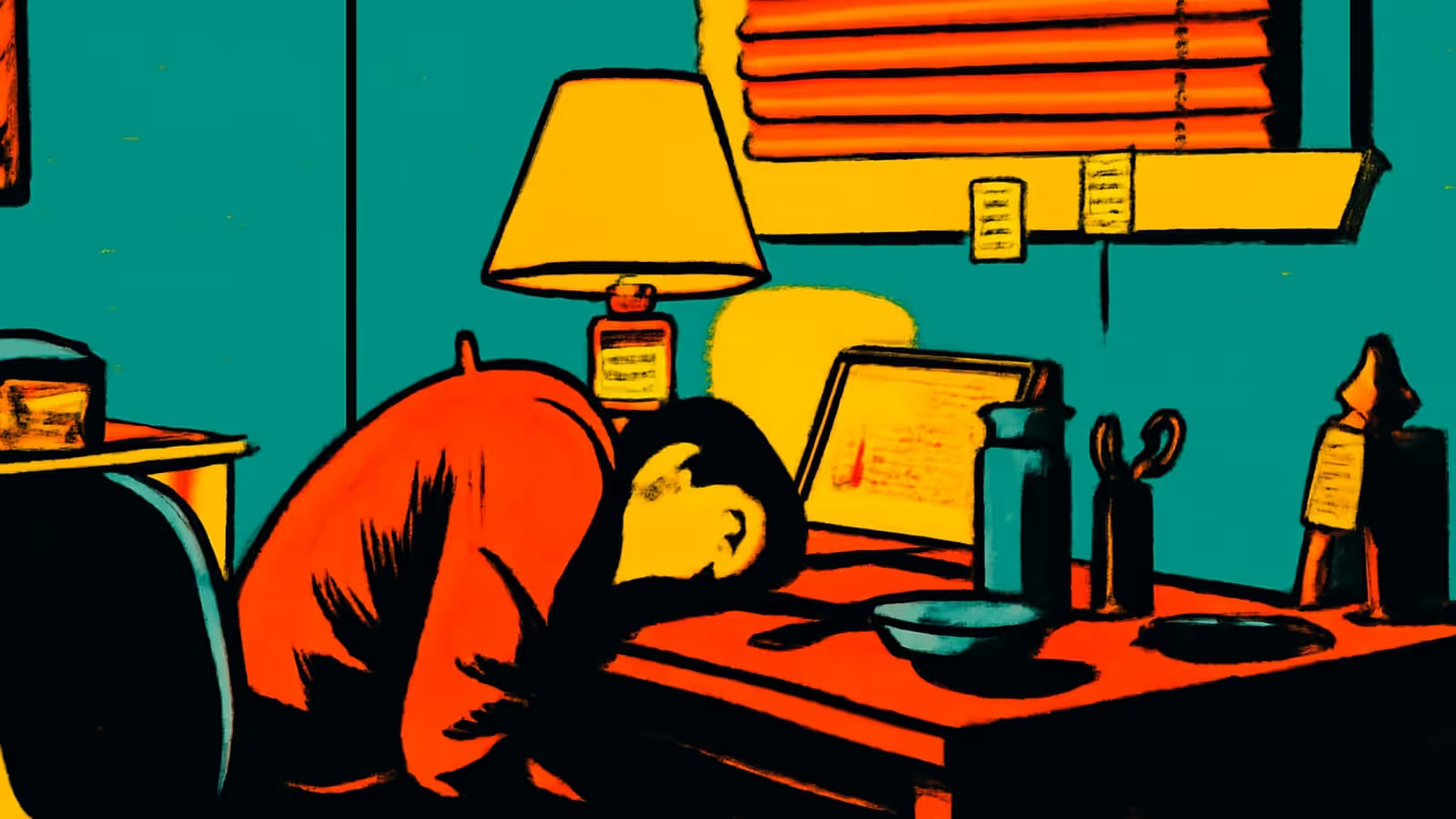
Decision fatigue is the claim that choosing uses up a limited mental resource, so your later decisions are worse than your earlier ones. The everyday experience behind it is familiar to everyone, and the science usually cited for it is in considerably worse shape than its popularity suggests.
That matters, because the popular version tells you something specific and probably wrong about why choices get harder. The practical advice survives anyway, for better reasons.
The study everyone cites
The famous finding is that parole boards granted release about 65 percent of the time at the start of a session and almost never by the end, with the rate returning to 65 percent after a food break. [danziger-parole] It was reported worldwide as proof that justice depends on when the judge last ate.
A schematic of the pattern described in the 2011 parole study, drawn to show shape rather than reproduced from the published data.
It is a striking shape, and it is the reason the phrase entered general use. It is also the point at which most retellings stop.
The problem with it
A response published in the same journal argued that the cases were not heard in random order, which would produce the same curve without any fatigue at all. [weinshall-critique] If the sequence of cases itself predicts the outcome, a decline across the session tells you about the scheduling rather than about the judge.
The specific points raised were that prisoners with legal representation tended to be heard earlier, and that cases were grouped in ways that correlate with the likely verdict. The original authors replied and defended their conclusion, so this is a live disagreement rather than a retraction. What it is not is the settled fact it is usually presented as.
What happened to the theory underneath
Decision fatigue was built on ego depletion, the idea that self-control draws on a limited resource, and that idea did not survive a proper test. A preregistered replication run across 23 laboratories with 2,141 participants found no meaningful effect. [hagger-ego-depletion]
This is about as clear a result as psychology produces. It does not prove that nothing resembling depletion ever happens, but it does mean the mechanism that gave decision fatigue its scientific respectability is no longer something you can lean on. Any article that explains your afternoon slump by a depleted store of willpower is describing a theory that has been tested at scale and did not hold up.
So why do choices genuinely get harder?
Because of things that were never in dispute and never needed a depleting resource to explain them. Tiredness degrades judgement, hunger affects mood and attention, time pressure narrows how much you consider, and having many similar options makes choosing measurably harder and satisfaction lower.
These are ordinary, well-supported effects, and between them they account for the experience the phrase was invented to describe. The practical difference is that they point at different fixes. A depleted resource implies rest and glucose; the actual mechanisms imply scheduling, sleep and cutting down the number of options in front of you.
Which of these is actually driving your afternoons?
These are the mechanisms with solid evidence behind them. Tick anything that is usually true of your day.
0 of 6 ticked
Most of what makes decisions harder is present in your week. That is good news in the sense that these are schedule problems rather than character problems.
A couple of the well-supported mechanisms are in play. Each has a specific fix, which is more useful than a general resolution to have more willpower.
Little here matches the common causes. If your decisions still feel harder as the day goes on, sleep quality is the first thing worth examining.
This is not a screening tool. No validated self-assessment measures decision fatigue, and none on this site claims to.
What still holds up
Front-load the decisions that matter, reduce how many decisions you face, and be suspicious of anything you decide when tired. None of this depends on ego depletion being true, which is precisely why it is worth keeping.
Three specifics. Make routine things automatic rather than deciding them fresh each day, which removes the choices rather than managing them. Cut the option set instead of researching it more, because more comparable options reliably make choosing harder. And treat late-night decisions as drafts to be reviewed in the morning, which is the single most robust piece of advice in this entire area.
The wider habit of turning a decision over without ever closing it is a different problem. Our pillar on overthinking covers why the mind loops, and our article on how to stop overthinking covers what interrupts it.
When to seek help
Speak to a doctor if the difficulty deciding is new, persistent and extends to things that used to be easy, particularly alongside low mood, loss of interest or sleep changes. Difficulty concentrating and making decisions is a recognised feature of depression, and it is one of the symptoms people are least likely to connect to it.
It is also worth raising if the indecision is driven by fear of getting something wrong rather than by tiredness, since that is a different mechanism with different treatment. If small decisions produce disproportionate anxiety, or you find yourself checking and rechecking a choice you have already made, that is worth describing to a professional rather than managing with productivity techniques.
How MyFreud can help
MyFreud’s tracking is useful here for one unglamorous reason: it shows you when in the day and week your mood and energy actually drop, rather than when you assume they do. Since the practical fix for hard decisions is mostly scheduling them better, knowing your own real pattern beats applying a general rule about afternoons.
Download MyFreud and start today: App Store or Google Play.