
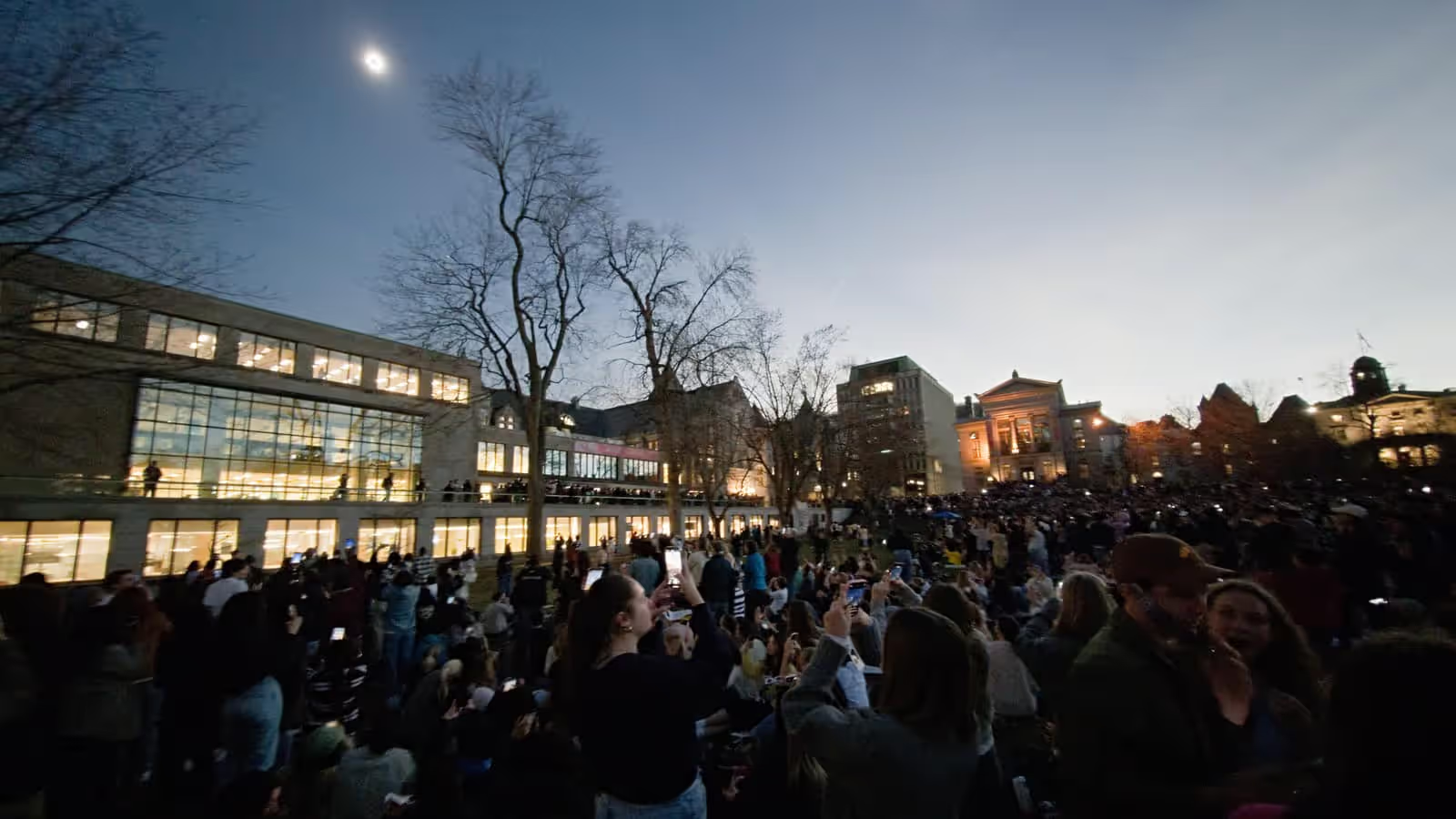

The 2026 solar eclipse is already one of the most searched things in the United States, months ahead of the event, which is a good illustration of the thing itself: people are already anticipating an emotion. Awe is one of the more useful states in psychology and one of the least deliberately pursued, and the interesting part is that the mechanism is well enough understood that you do not have to wait for an eclipse to use it.
What awe actually is
Awe is the response to something vast that your current understanding cannot quite accommodate. Researchers settled on those two conditions, perceived vastness and a need for mental accommodation, and both have to be present. [keltner-haidt]
That second condition is why the emotion fades with familiarity. A mountain you have never seen produces awe; the same mountain on your two hundredth commute past it produces nothing, because your frame of reference has expanded to include it and there is no longer anything to accommodate. Vastness alone gives you impressed. Vastness plus a small failure of your existing model gives you awe.
It is also why vastness need not be physical. A piece of music performed live, a person doing something extraordinarily skilled, a very old tree, or an idea that reorganises something you thought you understood all qualify. The common feature is scale that exceeds your ready-made categories.
The small self, and why it helps
Awe reliably shrinks your sense of your own significance relative to what you are looking at, and this is the useful part rather than an unfortunate side effect. [piff-awe] People describe their own concerns feeling smaller afterwards, and describe it as relief rather than as diminishment.
This is worth separating from what most techniques do. Almost everything else aimed at worry works on the contents of the frame: challenge the thought, test the prediction, rate the evidence. Awe does not engage the contents at all. It changes the size of the frame, so the same worry occupies less of it. For anybody who has found that arguing with an anxious thought mostly produces a better-argued anxious thought, that difference is the whole appeal.
The effect is modest and short-lived, which is an argument for having it often rather than for planning one spectacular experience a decade.
- Own concerns feel smaller 38%
- More time feels available 27%
- More patient and generous with others 22%
- Nothing much changed 13%
A schematic of the effects described in this article, to show relative share rather than measured data.
The time effect
People report feeling they have more time available after awe, which is genuinely unusual. Most pleasant states do not do this; a good mood does not, and neither does amusement or pride.
Nothing about the schedule has changed, so what appears to shift is the sense of time pressure rather than time itself. The plausible reading is that time scarcity is partly a function of how much of your attention your own agenda is occupying, and awe temporarily reduces that. Whatever the mechanism, it is the finding most likely to be useful on an ordinary Tuesday, because the feeling of having no time is one of the more corrosive daily experiences and is only loosely related to how much time you have.
Why an eclipse works so well
Because it maximises both conditions and adds a third that the research on solitary awe misses. It is vast, it violates the single most dependable expectation a person holds, that daylight simply continues, and it happens to everybody standing near you at the same moment.
Collective awe is more intense than the solitary kind, which is why people who have seen one describe the crowd as part of the experience rather than something they had to tolerate. It is also why the recordings disappoint. A screen removes the scale, and scale was the thing the emotion was responding to.
Two practical notes if you are planning around one. Anticipation is not the emotion, and the months of looking forward do not deliver any of the above. And never look at the sun without proper eclipse filters, including through a phone camera, binoculars or a telescope, none of which protect your eyes and some of which concentrate the damage.
Getting it without an eclipse
Vastness is the requirement, and it is more available than people assume. The reliable sources, roughly in order of how easy they are to arrange:
- A genuinely dark sky. The most consistently effective and the most logistically annoying, because it requires getting away from streetlights. Worth one trip to find out whether it works on you.
- Weather at scale. A storm coming in across open ground, the sea in bad conditions, standing somewhere very high.
- Live music, loud, in a room with other people. This covers the collective element as well.
- Very old or very large living things. Ancient trees do this to people reliably.
- Watching someone do something extraordinarily well, in person rather than recorded.
- Buildings built at a scale that was unreasonable for their era.
The consistent failure is the screen. The consistent requirement is being there.
A three-minute look at something vast
Go outside, or to a window with the largest view available to you, and give it three uninterrupted minutes. No phone, no photograph. The instruction is only to look at the biggest thing you can see and let it be as big as it is.
3:00
If your attention returns to your own concerns, that is expected. Move it back to the largest thing in view rather than to your breath.
Done. Notice whether anything about the size of today's problems has shifted.
Where this fits with everything else
Awe is not a treatment and should not be offered as one. It will not resolve a depressive episode, and telling somebody in one to go and look at some stars is the kind of advice that lands as dismissal, because anhedonia specifically removes the capacity to be moved by things.
It also has a shadow version worth naming, because the same trigger does not always land as wonder. A sense of vastness that will not fit your existing frame can arrive as a cold recognition of your own smallness instead, which our piece on existential dread covers, along with why arguing with the thought makes it louder.
What it is good for is the ordinary condition of your own concerns filling the entire frame: the week where everything feels enormous and adjacent, and where more thinking has stopped producing more clarity. It sits alongside the attention practices in our mindfulness guide rather than replacing any of them, and it has one practical advantage over most of them, which is that it requires no technique at all. [apa-mindfulness] You only have to go and stand somewhere and look at the thing.
When to seek help
Speak to a doctor or a therapist if low mood, anxiety or stress has lasted more than a few weeks and is changing what you do. Awe, exercise, sleep and the rest are real contributors to wellbeing and none of them is a treatment for a depressive episode, so a persistent low mood is a reason to ask rather than to try harder.
Go sooner if nothing moves you at all any more, including things that reliably used to. That specific loss is a recognised symptom rather than a mood, and it is one of the more treatable ones.
Contact your local emergency services or a crisis helpline if you feel unsafe or have thoughts of harming yourself.
How MyFreud can help
MyFreud is a mobile app that helps you find solutions to problems that have affected your mind and productivity. Live coaching sessions give you somewhere to work out which of your problems is genuinely large and which has only grown to fill the frame, each session ends with an actionable plan rather than a feeling, daily tracking shows which weeks the frame narrows, and the notepad is where the vast thing you saw goes so it survives past the evening.
Download MyFreud and start today: App Store or Google Play.