
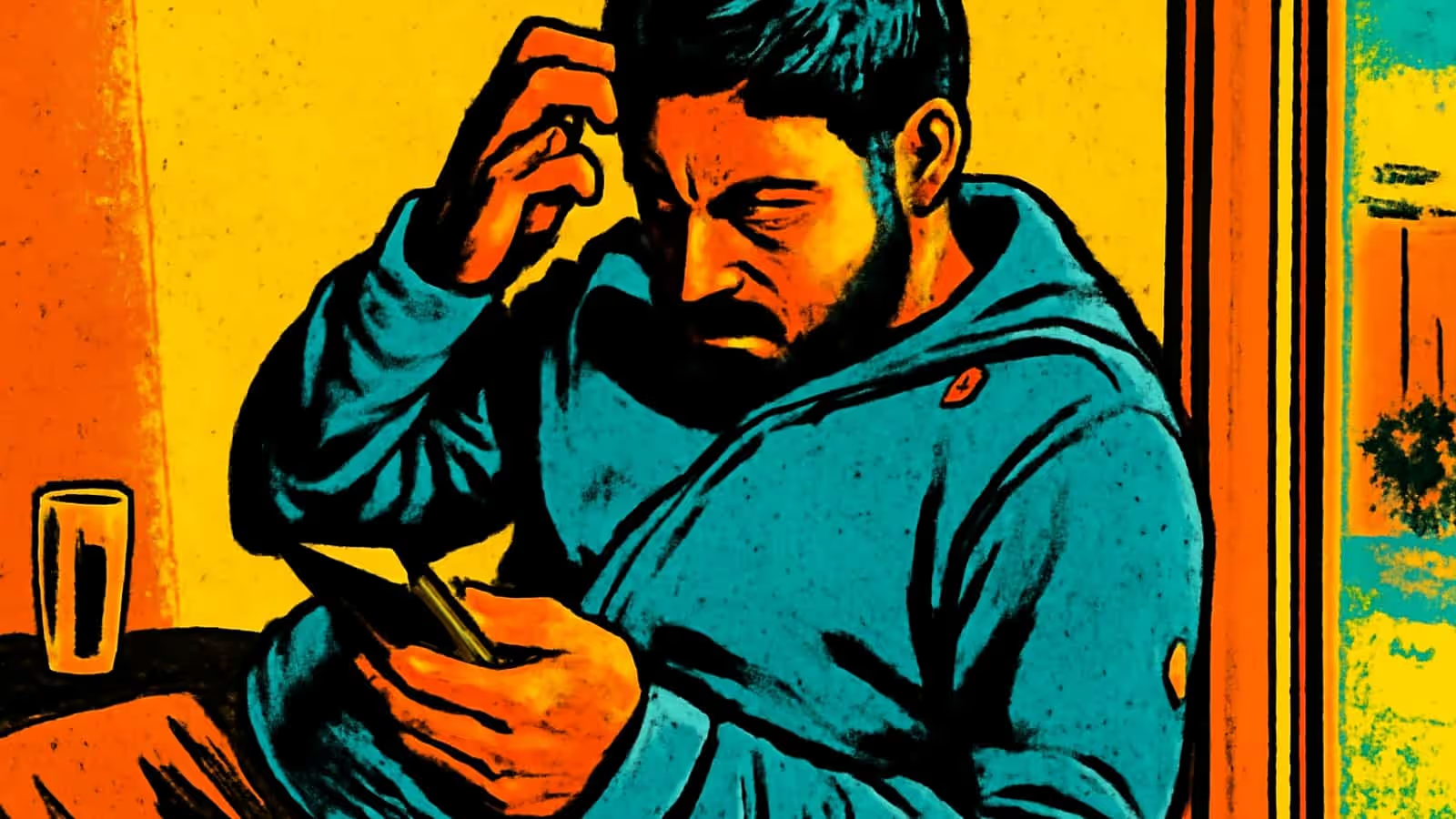
A drug-resistant fungus called Candida auris pushed into the search trends this week, which is what happens roughly every few months to some pathogen or other. For most people that means a headline read once and forgotten. For anyone with health anxiety it means a fortnight, and the thing that makes those two weeks worse is not the pathogen. It is what you do in the six hours after reading about it.
Why outbreak coverage lands so hard
Because it supplies exactly the two ingredients health anxiety runs on: fresh uncertainty, and a list of symptoms to check yourself against. A story about a new resistant organism is not simply frightening information; it is a task, and the task is to establish whether this applies to you, which is the one task that cannot be completed.
It also arrives in a format optimised against you. Coverage is built around the most alarming true statement available, because that is what gets read, and the most alarming true statement is almost never the most likely outcome. “Resistant to multiple antifungal drugs” and “your chance of encountering this is negligible” can both be accurate about the same organism, and only one of them is a headline.
What the headline usually leaves out
Three things, and all three are normally in the article itself: who is actually getting ill, where transmission happens, and what the number is out of.
Take the current example. Candida auris is a genuine concern and sits in the critical group of the World Health Organization’s fungal priority pathogens list, which is not a trivial designation. [who-fungal] What that designation is about is drug resistance and the difficulty of eradicating it from healthcare environments. The people who become seriously ill are overwhelmingly those already seriously ill: long hospital admissions, intensive care, invasive lines and tubes, immune systems already compromised. It is a hospital infection-control problem, and that is a very different thing from a community threat to somebody reading about it at home.
That structure repeats across almost every pathogen that trends. The organism is real, the concern is real, the professional worry is about settings and resistance, and the person most frightened by the coverage is frequently the person least likely to be affected by it.
A schematic of the pattern described in this article, not measured coverage.
Why searching makes it worse
Because relief that arrives in minutes and fades in hours is a reinforcement schedule, not a solution. Each search that settles the fear teaches your anxiety that checking works, so the next spike arrives with a stronger instruction to check, and the interval between needing to check gets shorter.
This is the core mechanism of health anxiety and the reason facts do not fix it. You are not short of information; most people with health anxiety are unusually well informed about the things they fear. The problem is that certainty is unavailable, and every search is an attempt to obtain it, which means every search ends slightly short and hands the fear a reason to continue.
The same applies to the other forms this takes, which are worth naming because they often do not feel like searching:
- Body checking. Examining, pressing, looking, testing whether the sensation is still there.
- Reassurance seeking. Asking someone close to you whether they think it is serious, repeatedly.
- Comparison scrolling. Reading other people’s accounts to work out whether yours matches.
- Avoidance, which is checking’s mirror image and maintains the fear just as effectively.
Our article on reassurance seeking goes into that mechanism in detail, and illness anxiety disorder covers where the pattern becomes a diagnosis.
How to read health news without feeding it
Deliberately and once, from a source that publishes base rates. Total avoidance is not the answer, because avoidance is itself a safety behaviour and it leaves you at the mercy of whatever reaches you by accident, usually in its most alarming form.
What works in practice:
- One source, one time, at a fixed point in the day. Not an algorithmic feed, which is selected for engagement rather than accuracy, and not continuously.
- Read the article, not the headline, and specifically look for who is getting ill and in what setting. If a piece does not tell you, that is information about the piece.
- Read rather than watch where you can. Video repeats the emotional content without adding facts.
- Do not search afterwards. This is the hard one and the one that matters. Decide before you read that you will not follow it with symptom checking, and treat the urge as the symptom rather than as a question.
- Set a delay rather than a ban. “Not now, and I will look at six if I still want to” is easier to keep than “never”, and the urge has usually gone by six, which is itself useful evidence.
The delay, rather than the ban
When the urge to search arrives, start this and do something else until it finishes. You are not forbidding the search, you are postponing it, which is far easier to keep and produces the evidence that matters: the urge falls on its own without being answered.
10:00
Do something that occupies your hands. The urge is not a question waiting for an answer.
Time is up. Is the urge still as strong as it was?
What actually treats it
Cognitive behavioural therapy adapted for health anxiety, which works by changing behaviour rather than by proving anything about your health. Trials in medical settings have found it effective and durable, including in people who first presented in hospital clinics rather than through mental health services. [tyrer-cbt]
The part people find surprising is that treatment does not involve establishing that you are well. It involves gradually reducing the checking, searching and reassurance-seeking while learning to tolerate the uncertainty underneath, and it is uncomfortable at first for exactly that reason. What changes is not your level of certainty, which stays where it always was, but how much certainty you need in order to get on with the day. [apa-anxiety] Our guide to CBT for health anxiety covers what a course actually involves, and the health anxiety guide covers the wider picture.
What did you do after the last health story?
Tick anything you did in the day after the last health scare you read about. This is a reflection prompt rather than a test, and it produces no diagnosis.
0 of 6 ticked
This is the recognised pattern of health anxiety rather than an appropriate response to a news story, and it is treatable with a specific therapy. The single most useful change is not believing different things, it is answering the urge less often. Ask for cognitive behavioural therapy for health anxiety by name.
One or two of these after a genuinely alarming story is common. What turns it into a problem is frequency, so the thing to watch is whether the interval between needing to check is getting shorter. Postponing rather than forbidding is the cheapest intervention available.
Reading once and moving on is the behaviour everything above is trying to reach. Nothing here suggests the loop has hold of you.
When to seek help
Speak to a doctor or a therapist if you are searching symptoms most days, if checking or reassurance-seeking is taking up real time, or if fear about your health is affecting your sleep, work or relationships. Ask for cognitive behavioural therapy for health anxiety specifically, because general counselling and general reassurance both tend to feed the loop rather than interrupt it.
Go sooner if you are avoiding medical appointments you actually need, which is the version of this that carries real physical risk, or if you are requesting tests repeatedly and the relief from each one is getting shorter.
Contact your local emergency services or a crisis helpline if you feel unsafe or have thoughts of harming yourself.
How MyFreud can help
MyFreud is a mobile app that helps you find solutions to problems that have affected your mind and productivity. Live coaching sessions give you somewhere to take the fear other than a search bar, each one ends with an actionable plan rather than reassurance, daily tracking shows whether the checking is actually reducing over weeks, and the notepad is where the question goes so it can wait rather than being answered immediately.
Download MyFreud and start today: App Store or Google Play.