
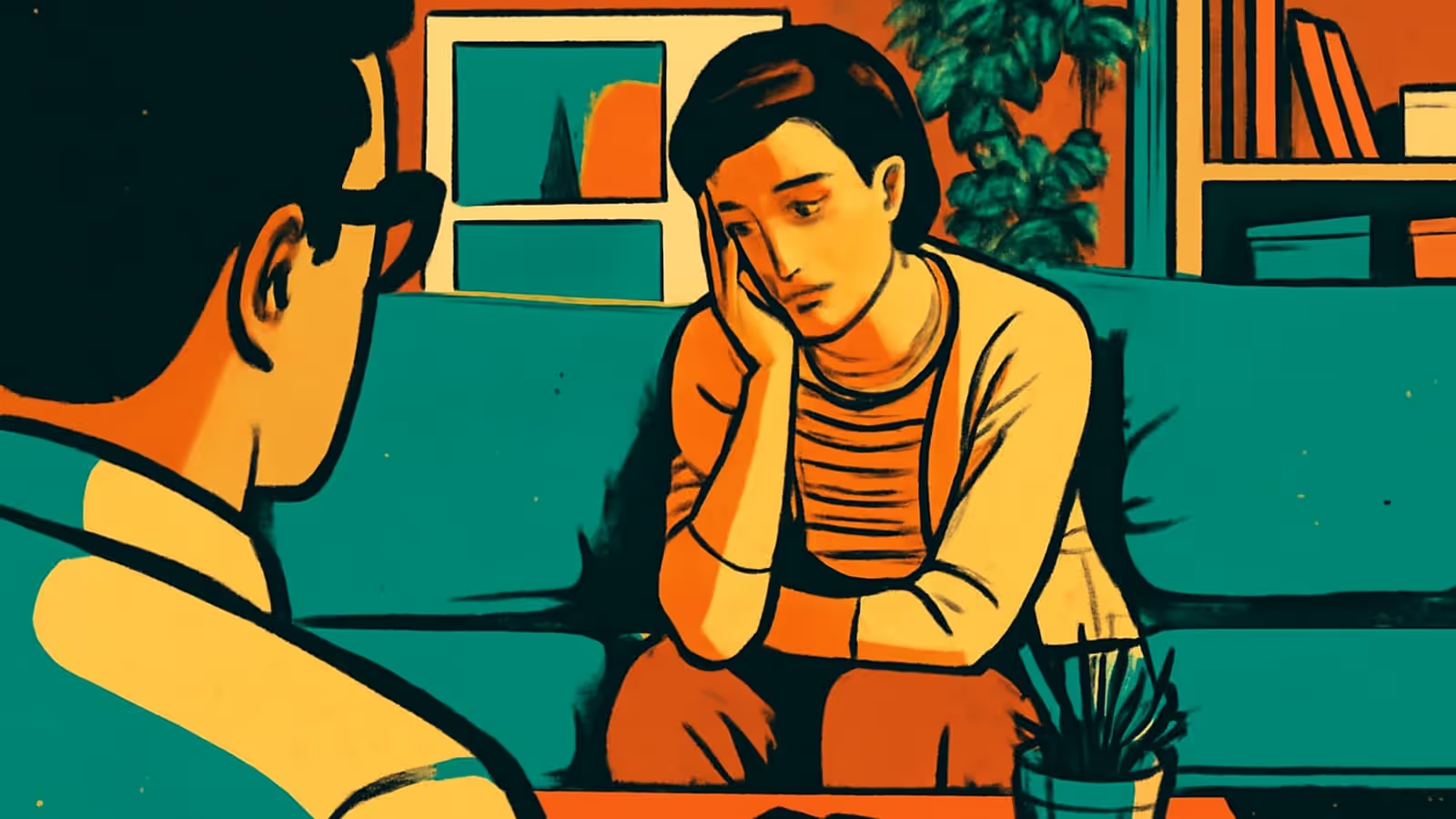
Cognitive behavioural therapy for health anxiety works, takes about five to ten sessions, and does not require you to agree that nothing is wrong before you start. Those three facts are the ones that decide whether people seek treatment, and they are rarely the ones they hear.
What follows is what the sessions actually contain and what the trials actually found, because “CBT can help” is the kind of sentence that persuades nobody to book anything.
What the evidence shows
The strongest single trial was run where health anxiety actually presents. Researchers randomised 444 patients attending medical clinics across six hospitals to either five to ten sessions of CBT or standard care, and roughly twice as many in the CBT group reached normal levels of health anxiety, with benefit sustained over subsequent years and no significant difference in overall cost. [tyrer-2014-champ-cbt]
The wider picture agrees. A meta-analysis of 13 randomised controlled trials covering 1,081 participants found CBT outperformed control conditions on primary outcome measures both at the end of treatment and at follow-up. [olatunji-2014-meta]
Two features of the large trial are worth pulling out, because they change who this applies to. It was delivered in medical clinics, not psychiatric ones, so it reached people who had come in about their heart or their gut rather than about anxiety. And the courses were short. Whatever you are imagining when you picture therapy, this is less than that.
Clinically significant health anxiety is also common, reported at rates as high as roughly one in eight adults in general populations. [scarella-2019-iad-cbt] You are not an unusual case.
What the sessions actually contain
The work targets what the checking is doing to you rather than whether your fear is justified. That distinction is the whole design, and it is why treatment can start before you have conceded anything.
Broadly four components, usually overlapping rather than sequential:
- Finding the specific prediction. Not “I am worried about my health” but “this ache means bowel cancer and I will be dead within the year”. General fears cannot be tested; specific ones can.
- Mapping what you do about it. Searching, body checking, asking a partner, requesting tests, and also the avoidance: the letter unopened, the appointment not booked.
- Testing the prediction by changing the behaviour. Deliberately not checking, and watching what the anxiety actually does over the following hours. This is the active ingredient, and it is the part that requires nerve.
- A plan for the next symptom. Everyone gets ordinary illnesses. Without a plan, the first real symptom after treatment restarts the whole cycle.
Some therapists also work on attention, because health-anxious people scan their bodies far more than other people do, and scanning reliably finds something. A body examined closely enough always produces a sensation to worry about.
The part people are not warned about
Anxiety goes up before it comes down, and treatment fails most often at exactly that point. Reassurance genuinely works in the short term, so removing it means the spike is no longer being cut off early.
A schematic of the maintenance cycle and its interruption, not measured data. Individual courses vary; the shape is the point, not the numbers.
Read the second panel honestly: it is a worse fortnight in exchange for a much better quarter. A therapist who does not warn you about the week two spike has set you up to conclude the treatment is harmful at the moment it starts working.
Getting it, and what to ask for
Ask your doctor for a referral to a talking therapy service, and check whether yours takes a referral you make yourself, since a good many do. Say the words health anxiety, and say that reassurance stops working within days. That second detail is what routes you correctly, because it distinguishes this from generalised anxiety.
Questions worth asking a prospective therapist:
- “Have you treated health anxiety specifically?” The protocol differs from generic anxiety work.
- “Will we be reducing reassurance-seeking?” If the answer is vague, that is the wrong therapist. This is the active ingredient.
- “How many sessions are you thinking?” An answer in the five-to-twenty range fits the evidence.
What to expect it not to include: persuading you that you are healthy, reviewing your test results together, or debating individual symptoms. A therapist declining to do those is applying the model, not dismissing you.
Our guide to why reassurance makes health anxiety worse covers the loop this treatment interrupts, and CBT for intrusive thoughts covers the same mechanism in OCD, which health anxiety closely resembles. Where prominent physical symptoms are present rather than fear alone, our guide to somatic symptom disorder covers the diagnosis that applies and why it does not mean the symptom is imagined.
Is this treatment aimed at you?
Tick anything true of the last few months. This is a reflection prompt rather than a test, and it produces no diagnosis.
0 of 8 ticked
Reassurance that wears off quickly, alongside checking that takes real time, is exactly the presentation the CHAMP trial recruited. Five to ten sessions is the realistic scale. If you ticked the last item, that is the single thing to change this week.
A few of these are common after any health scare. The one worth watching is whether the interval between spikes is shortening, because that is the sign the loop is establishing itself rather than settling on its own.
Not much here matches the cycle this treatment targets. Worry about a specific symptom is ordinary, and the right response to that is an appointment with a doctor about the symptom.
No screener on this site is specific to health anxiety. The free anxiety screener uses the GAD-7, which measures generalised anxiety rather than illness preoccupation, so read it as a general signal. It takes about two minutes and nothing is sent anywhere.
When to seek help
Ask for a referral if checking or searching takes up significant time, if reassurance stops working within days, or if you have had clear investigations that did not settle the fear. Some talking therapy services take a referral you make yourself, so it is worth asking before you wait for one.
Keep seeing a doctor about genuinely new physical symptoms in the normal way. Treatment for health anxiety is about proportionate checking, never about ignoring your body.
Go urgently if you have thoughts of harming yourself.
How MyFreud can help
The detail that makes this treatable is how fast reassurance wears off, and it is the one thing nobody can reconstruct in a ten-minute appointment. MyFreud gives you daily mood tracking that shows the interval between spikes across weeks, which turns a vague account of constant worry into something a therapist can work from in session one.
Download MyFreud and start today: App Store or Google Play.