
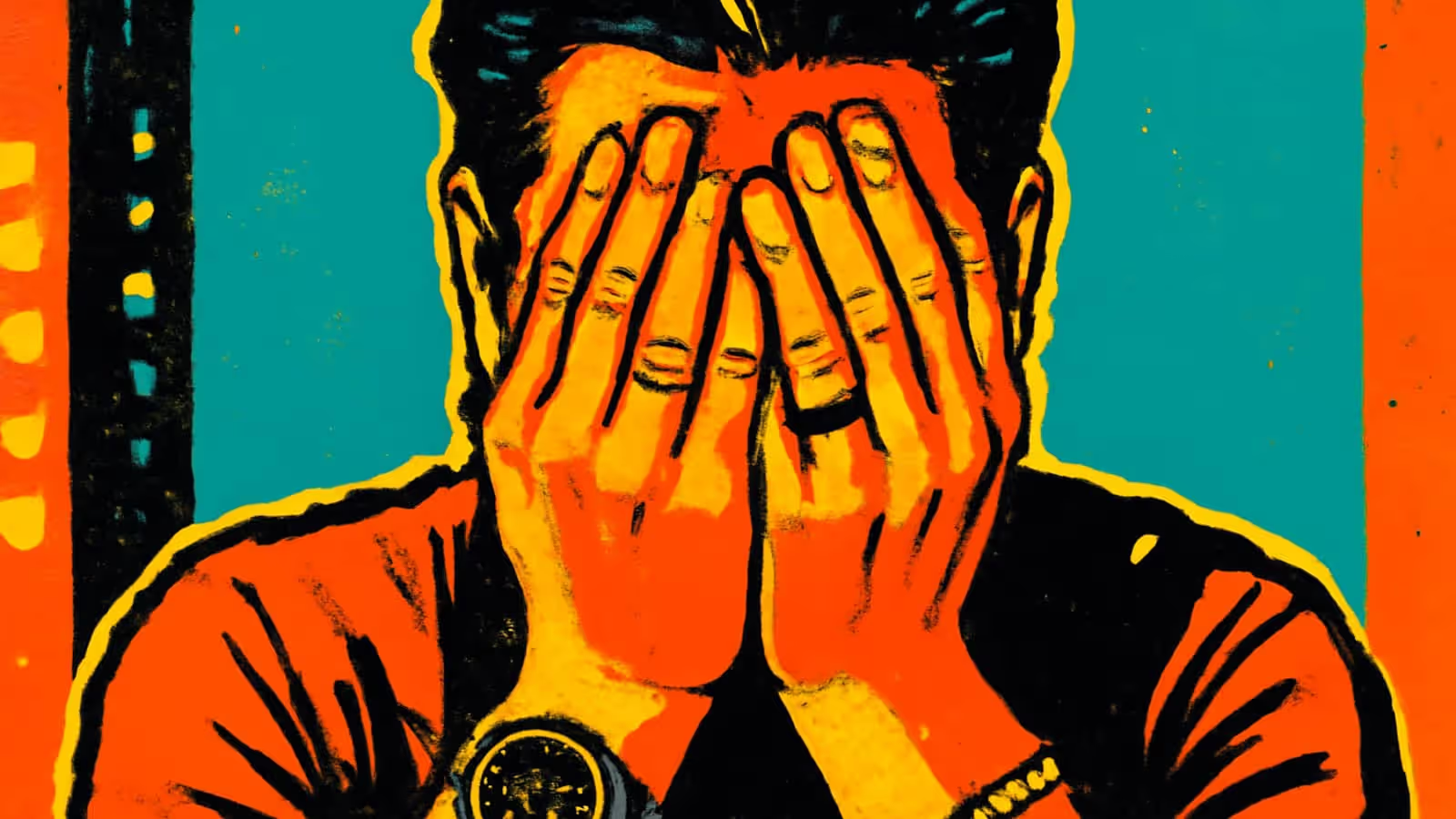
Anger is one of the most common experiences in bipolar disorder and one of the least discussed. It behaves as a symptom, in the same way low mood and racing thoughts are symptoms, and it does more damage to relationships than either of them, because everybody in the room reads it as character rather than as illness. What follows is written for both sides of that room: the person whose fuse has got shorter and cannot say why, and the family trying to work out whether this is an episode or a bad week.
Is anger a symptom of bipolar disorder?
Yes, and it is written into the diagnostic criteria rather than being a by-product of having a difficult life. Irritability appears in all three phases of the condition, which used to be called manic depression: during highs, during lows, and in the mixed states that carry both at once.
Saying this plainly matters because of the explanation that arrives when nobody says it. The alternative reading is that the person is simply difficult, and everybody gets there quickly. Families get there. Employers get there. The person themselves gets there with more conviction than anyone else, files it alongside everything else they believe is wrong with them personally, and stops mentioning it. That conclusion is the one interpretation of the situation that leads to no treatment at all.
None of which makes anger the property of the illness. A person with bipolar disorder gets to be annoyed about the same things everyone else is annoyed about, and the section on the three different angers below is about protecting that.
A schematic of the pattern described in this article and in the studies cited. Not measured data.
A manic episode can present as fury rather than euphoria
The mood criterion for a manic or hypomanic episode is abnormally and persistently elevated, expansive or irritable mood, and the word doing the work is “or”. [apa-2022-dsm5tr] Somebody can meet it entirely through irritability, with no euphoria anywhere in the picture.
This is why the sentence “but he wasn’t euphoric, he was furious” is not the argument against bipolar disorder that people take it for. It is one of the two ways the criterion is written to be met. The popular image of mania is somebody buying a car and feeling magnificent, and a great deal of mania looks nothing like that: it looks like a person wound tight, intolerant of being interrupted, and impossible to disagree with without a row.
One qualifier keeps this from being useless. Since 2013 the criteria have required a clear rise in goal-directed activity or energy alongside the mood change, not mood on its own. So irritability by itself is not an episode. Irritability plus a jump in activity, speech and drive is the pattern worth taking to a doctor, and that pairing is the most useful distinction in this article. Our guide to hypomania covers where that line falls when the activation is milder.
Irritability during depression is the half nobody expects
Bipolar depression is frequently irritable rather than sad, and this is where a large share of the anger actually lives. In a cohort of 142 people with bipolar I or II assessed during a major depressive episode, at least one manic symptom was present in 76 per cent of episodes, and overt irritability was the most common of them at 57 per cent, followed by psychomotor agitation at 39 per cent. [judd-2012-subsyndromal]
Read the ranking rather than the decimal place. That was one cohort in one long-running study rather than a population survey, so the durable finding is that irritability was the manic symptom found most often sitting inside a bipolar depression, not that the figure is exactly 57.
A smaller study looked specifically at anger attacks, meaning sudden bursts of intense anger with a physical rush attached, in outpatients who were in a pure depressive episode. It found them in 62 per cent of the 29 people with bipolar disorder, against 26 per cent of the 50 with unipolar depression. [perlis-2004-anger-attacks] What that study did not establish is that anger attacks identify bipolar disorder. A quarter of the unipolar group had them as well, 29 people is a small sample, and everybody in it was already attending a specialist clinic, which is not the population most readers are in.
The pattern is also why irritability is so often the presenting feature in young people. For children and adolescents the criteria explicitly permit irritable mood in place of low mood in a depressive episode, so a teenager whose depression looks like temper is not an exception to the rule but an example of it. [apa-2022-dsm5tr] Our guide to why irritability happens and what causes it covers the same shape outside bipolar disorder, where sleep debt and depression are the two causes worth ruling out first.
The presentation most likely to be missed
Mixed features carry the strongest association with irritability and agitation of any state in bipolar disorder, and they are also the state clinicians most often fail to record. A mixed picture means an episode of one pole carrying symptoms of the other: depression with racing thoughts and restlessness, or a high with despair running underneath it.
That combination is the reason this article does not stop at “irritability comes from mania”. Somebody can be hopeless and agitated in the same hour, and the agitation supplies energy that severe depression would otherwise have taken away. Our guide to mixed features in bipolar disorder covers what that means for risk and for prescribing, which is beyond what a piece about anger can usefully carry. If the state you are reading about is low and wired at once, read that one next.
Three different angers, and telling them apart is most of the work
Almost every argument about anger in bipolar disorder happens because three separate things are being treated as one.
Episode-driven anger moves with the illness. It arrives with other changes, holds for days or weeks, and recedes when the episode does. This is the one that responds to treating the illness, and it is the only one of the three that treatment has anything to say about.
Ordinary anger is anger about things worth being angry about. Bad management, an unfair split of the housework, being talked over. A person with bipolar disorder has the same entitlement to this as anybody, and the risk of an article like this one is that it hands families a way to reclassify every disagreement as a symptom. That reclassification is corrosive in a way that is easy to underestimate: it removes the person’s standing to object to anything at all, and it is the most common complaint people with bipolar disorder make about how they are treated at home.
The question “have you taken your medication?” delivered mid-argument is where these two collide. Sometimes it is the right question. Used as a reply to a legitimate complaint, it ends the conversation, tells the person their objection has been read as pathology, and reliably produces the anger it was meant to diagnose.
Consequence anger is anger about what episodes have cost. Money spent, work lost, things said that cannot be unsaid, relationships that did not survive, and the ongoing experience of being watched by relatives for signs. This one is not a symptom and it does not fade when the episode does. It is a normal response to real losses, and it is what therapy is for rather than what medication is for.
Is this an episode or a bad week?
Ask whether it is a change from that person’s baseline, and what it is travelling with. Neither question needs a clinical opinion and both can be answered by anybody who has known the person a while.
| What to look at | Points towards an episode | Points towards a bad week | What to do either way |
|---|---|---|---|
| Sleep | Sleeping less, and not tired with it | Sleeping badly, and wrecked by it | Write down hours slept, daily, with the date |
| Onset | Shifted over a few days with no clear cause | Follows something specific that happened | Note the date it changed, not just that it did |
| Energy | Talking faster, more plans, starting more things | Doing less, withdrawing, cancelling | Record behaviour rather than how they seemed |
| Duration | Most of the day, most days, for a week or more | Comes and goes inside a single day | Give it a week before concluding, unless it is severe |
| Baseline | Not recognisable as them, even at their worst | A louder version of the usual them | Ask whoever has known them longest, not whoever is nearest |
The last row is the one that carries the most weight. Irritability that is continuous with how somebody has always been is a temperament question, and a poor reason to go looking for an illness. Irritability that people who have known them for twenty years describe as unlike them is a different thing entirely, and it is the observation clinicians find most useful when it is offered.
For the person on the receiving end of this list, one thing is worth saying directly. Being tracked is unpleasant, and the point of writing anything down is not surveillance. It is that episodes are genuinely hard to judge from inside, the recollection a week later is unreliable in a specific and predictable direction, and a record shortens an appointment considerably.
Track sleep, because it moves before anything else
Reduced need for sleep alongside rising irritability is one of the most reliable early warnings available. The distinction that makes it useful is between reduced need and ordinary insomnia: four hours and feeling fine the next day is a different signal from four hours and being destroyed by it, and only the first points towards activation.
This is why sleep is treated as a clinical priority in bipolar disorder rather than as general wellbeing advice, and our guide to bipolar disorder and sleep covers the evidence and what protecting it involves. For the purposes of anger, the practical version is short: log hours slept next to a one-to-ten irritability rating, daily, and look at the two together rather than separately. The pattern that matters is one falling while the other rises, over about a week.
There is no screener for bipolar disorder on this site
None of our free self-assessments covers bipolar disorder, and that is deliberate rather than an omission waiting to be filled. Bipolar disorder is identified from a history running over years, including episodes the person never registered as episodes and behaviour only other people noticed, which is not something a fifteen-question form can reconstruct.
The reason this matters more here than for most conditions is that telling bipolar depression from unipolar depression changes what treatment is appropriate, particularly around antidepressants, which are handled differently when a bipolar diagnosis is on the table. That is a conversation for a psychiatrist or a doctor, and never a reason to alter something you have already been prescribed. Our bipolar disorder guide covers how assessment actually works and what the treatments are.
When to seek help
Speak to a doctor or your psychiatrist if irritability has become a change from your baseline that has lasted more than a few days, and especially if it is arriving alongside less sleep, faster speech or more activity. Say those things in that order, because irritability on its own tends to get advice about stress management, while irritability plus reduced sleep and rising activity gets an assessment.
Go sooner if you feel hopeless and agitated at the same time, if the irritability is frightening you or the people around you, if you have started spending or acting in ways that are not like you, or if you have already been diagnosed and this does not resemble your usual pattern. For families, the strongest thing you can bring is a dated record of sleep and behaviour rather than an account of how somebody has been, and our guide to supporting someone with bipolar disorder covers what to agree in advance so that record already exists.
Contact your local emergency services or a crisis helpline if you feel unsafe or have thoughts of harming yourself.
How MyFreud can help
MyFreud is a mobile app that helps you find solutions to problems that have affected your mind and productivity. Live coaching sessions give you somewhere to separate the three angers rather than treating all of them as the illness, each one ends with an actionable plan instead of advice to stay calm, daily tracking puts sleep and irritability on the same chart so the pattern is visible before anybody has to argue about it, and the notepad is where the things said during an episode can be written down and dealt with later.
Download MyFreud and start today: App Store or Google Play.