
No, and the belief that you do is one of the more expensive ideas in this field. Rock bottom is a narrative device. It is how recovery stories get told once someone is out the other side, with the worst night cast as the moment everything turned, because that makes a better story than “a doctor asked me a few questions and I cut down”.
The evidence points the other way. The interventions with the best support are aimed at people who are not in crisis and are not asking for help.
Where the idea came from, and why it sticks
It is a hindsight artefact. Ask a hundred people in recovery what changed and many will describe a specific low point, because that is the shape memory gives to a long process. What that account cannot tell you is how many people changed without one, since nobody tells that story at a meeting. It is not a controlled comparison, it is the survivors describing the weather.
The idea sticks because it is useful to everybody in the short term. It gives the person using a reason to postpone, since things are not bad enough yet. That postponement usually hides behind a definitional question, and where the line between habit and addiction falls is worth settling before it does any more work for you. It gives families a script for waiting. And it converts inaction into a kind of strategy.
What the evidence says about early help
The clearest counter-evidence comes from brief interventions in primary care: short structured conversations with a doctor or nurse, involving feedback on how much someone is drinking, information about the risks, and advice on cutting down.
A Cochrane review of 69 trials found these conversations reduced alcohol consumption by an average of about 20g per week. The population matters as much as the effect. These trials recruited hazardous and harmful drinkers who were not actively seeking help for a drink problem. [kaner-2018-brief] That is the exact group the rock-bottom story says cannot be reached yet.
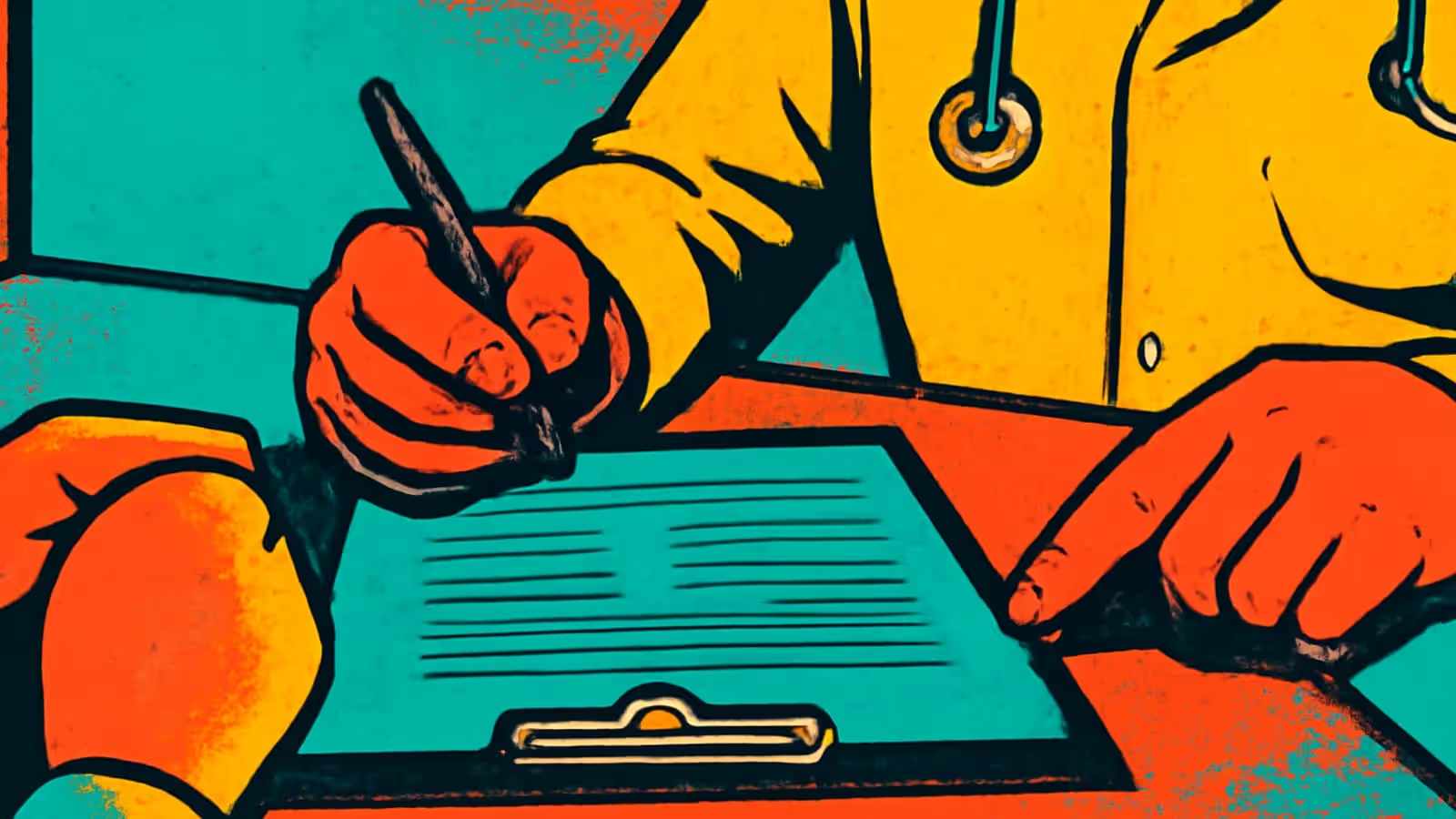
An illustration of the contrast between the folk model and the population studied in Kaner et al. (2018), which recruited hazardous and harmful drinkers not seeking help. Not measured data.
Motivation is not a prerequisite
The other half of the folklore is that someone has to want it, sincerely and unprompted, or it will not take.
Guidance from the National Institute on Drug Abuse addresses this directly: treatment does not need to be voluntary to be effective. Sanctions or encouragement from family, an employer or the criminal justice system can significantly increase both entry into treatment and how long someone stays. [nida-2018-principles] That is not an argument for coercion, and NIDA is careful to say it is not a licence for punitive measures without due process. It is an argument against the specific belief that a reluctant start predicts a failed one.
Motivation more often turns up partway through than at the beginning. Waiting for it before making an appointment is waiting for an outcome of treatment to arrive before the treatment.
What does predict how things go
Since severity at the start is a poor guide, the useful question is what actually correlates with getting better.
Staying in treatment long enough is the recurring one, along with treating any co-occurring mental health condition rather than the substance alone, and having some form of ongoing support once the formal part finishes. [nida-2018-principles]
On that last point the evidence has firmed up. A Cochrane review of Alcoholics Anonymous and twelve-step facilitation, the structured clinical approach to getting someone connected with those groups, found it performs at least as well as other established treatments such as cognitive behavioural therapy on most drinking outcomes, and better on continuous abstinence. [kelly-2020-aa] Note what is being measured: a route into ongoing support, available free, indefinitely. Not a rescue after a catastrophe.
Is it worth raising with someone?
Tick anything that has been true in the past few months.
0 of 6 ticked
Several of these together is worth raising with a doctor. Cutting down abruptly is not always safe with alcohol, so ask before you make a big change on your own.
One or two of these is exactly the stage the brief-intervention research targets, and the stage that feels too early to mention. It is not.
Nothing on this list stood out. If you were looking for permission to bring it up anyway, you do not need a qualifying score.
This is a prompt for reflection, not a test or a diagnosis. No validated substance-use screener is published on this site yet, so the link above goes to the assessments we do have.
The cost of waiting
If rock bottom were merely inaccurate it would be a curiosity. What makes it costly is that the low point is not a neutral waiting room. It is where the job goes, the relationship ends, the health problem becomes permanent, or the legal consequence lands.
Every one of those makes recovery harder afterwards, because they remove the things that support it. Waiting for a crisis to justify treatment means arriving at treatment with fewer resources than you had a year earlier.
For the wider picture of how addiction works and what treatment involves, see our guide to addiction and treatment.
For the family and friends watching this, there is an approach with better trial evidence than either confrontation or waiting. Our guide to how to help an alcoholic covers what a randomised trial actually found.
When to seek help
A doctor is the usual starting point, and you do not need to have decided anything before the appointment. Go sooner if you are drinking or using daily, if you have tried to stop and could not, or if anyone close to you has raised it more than once. If you have stopped before and gone back, our guide to relapse covers why one slip turns into a return, and why that is rarely about the substance.
One safety point: stopping alcohol suddenly after heavy daily drinking can be dangerous and occasionally life-threatening. If that describes you, get medical advice before you cut down rather than after.
If you are in crisis or thinking about harming yourself, contact your local emergency services or a crisis line in your own country.
How MyFreud can help
MyFreud does not treat addiction. What it offers is daily mood tracking that shows the pattern over weeks, which is useful here because the honest picture of how much and how often is the thing that is hardest to hold in your head and easiest to round down. Bringing a few weeks of actual entries to an appointment with a doctor beats trying to reconstruct them on the spot.
Download MyFreud and start today: App Store or Google Play.