
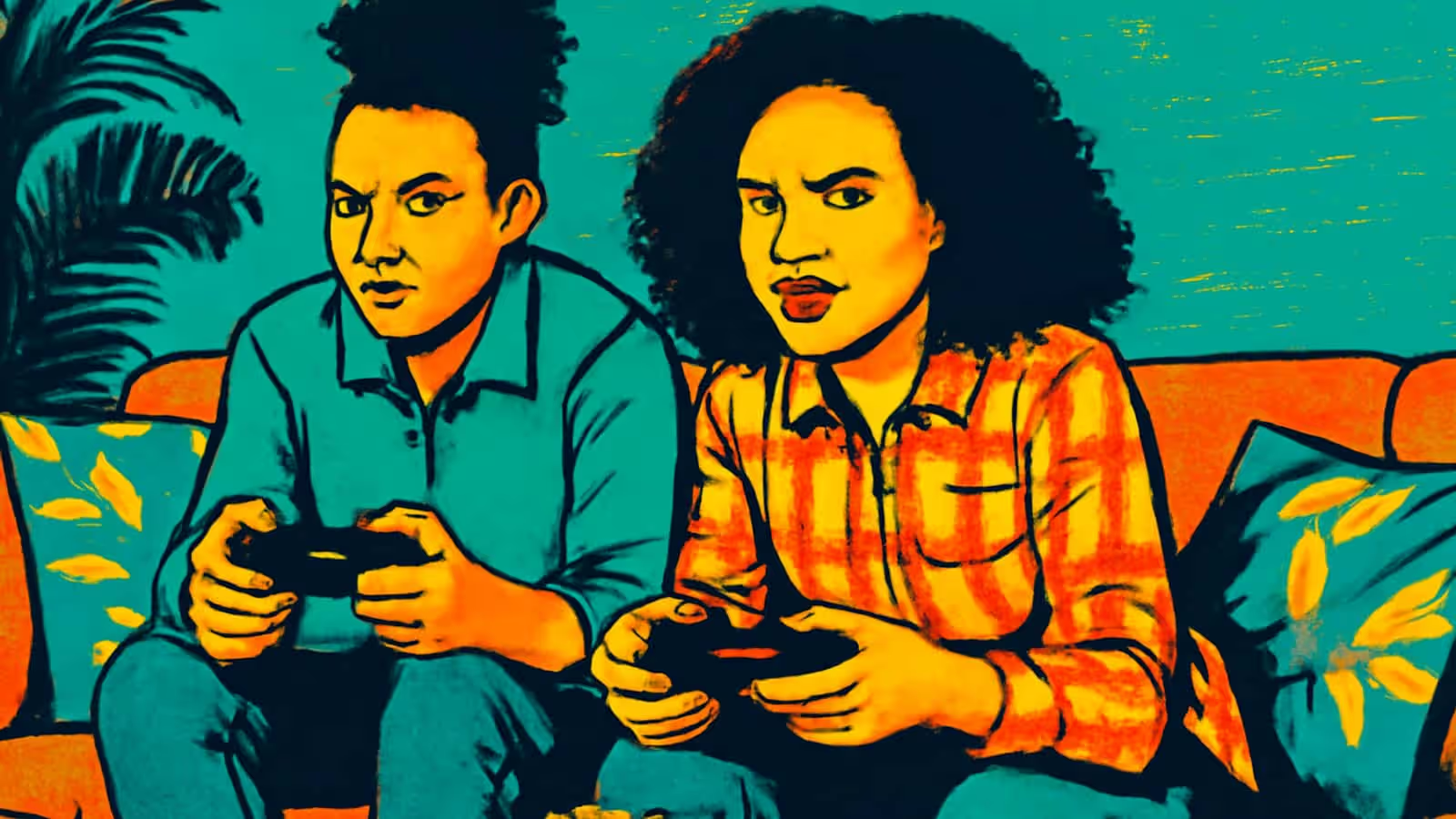
For most people, the number of hours spent playing video games tells you almost nothing about their mental health. That is not a hopeful framing of a worrying finding; it is what happened when researchers stopped asking players to estimate their play time and started getting the actual numbers from the games companies.
The reason it matters is that nearly every alarming headline about gaming rested on the estimate.
The problem was the measurement
Ask somebody how many hours they played last week and you will get a number. That number is not much use. Studies comparing self-reported screen and media use against logged use find the two agree poorly, and the error is not random: people who feel bad about an activity tend to overestimate how much they did it.
That single fact undermines a lot of research. If the exposure is measured badly, and the error correlates with the outcome you are measuring, you can produce a relationship out of nothing. Our overview of what screen time actually does covers the same problem in the wider literature, where the measured effects are much smaller than the public conversation assumes.
What happened with real play data
In 2021 a team at the Oxford Internet Institute did the obvious thing that nobody had been able to do before. Working directly with Electronic Arts and Nintendo of America, they obtained telemetry, meaning the companies’ own records of how long people actually played, and matched it to a wellbeing survey those same players completed.
The result, reported by Johannes, Vuorre and Przybylski, was that play time was associated with slightly higher wellbeing. [johannes-2021-telemetry] The effect was small, and the authors said so plainly rather than selling it. But the direction was the opposite of what most people expected, and it was measured properly for the first time.
And then it got smaller
The 2021 study covered two games. The follow-up was much bigger. Vuorre and colleagues worked with seven games companies and roughly 39,000 players, asking them to donate their play records, and tracked wellbeing over six weeks so that changes within the same person could be examined rather than differences between people.
The conclusion was that there was little to no evidence of a causal connection between time played and wellbeing in either direction. [vuorre-2022-unlikely] The effects were small enough that a player would need to put in implausible amounts of extra time to move their wellbeing by an amount anybody could notice.
This is the finding to hold on to, and it is less satisfying than either of the stories in circulation. Games are not quietly damaging most players. They are also not a treatment.
What did predict something
The same work found that motivations mattered. Play that satisfies somebody, that they chose and enjoy, sits differently from play driven by feeling obliged or by needing to be somewhere other than where you are.
That is worth taking seriously because it changes the useful question from how long to why. A person playing four hours because they are absorbed and it is their evening is in a different situation from a person playing four hours because stopping means thinking about work, and no hours-based rule can tell those two apart.
Is it the hours, or the reason?
Think about your last few sessions and tick what is true. This is a prompt for noticing rather than a test, and it produces no diagnosis.
0 of 5 ticked
Three or more, running for months, is the shape that clinicians ask about. Note that none of these items is about the number of hours, which is the point. What is being described is control and cost, and both respond to treatment.
Most people who game will tick something here in a given month. The signal worth watching is direction rather than count: whether this list has been getting longer over the past year.
That is the common result, and it matches what the population data would predict. Gaming is a leisure activity for most of the people who do it.
No screener on this site measures gaming. The hub above covers anxiety, depression, stress, sleep, burnout, self-esteem and loneliness.
Gaming disorder is real, and it is uncommon
None of the above means nobody is harmed. Gaming disorder is a recognised diagnosis, defined by impaired control over play, giving it increasing priority over other activities, and continuing despite clear negative consequences, typically over at least a year.
A meta-analysis by Stevens and colleagues put global prevalence at roughly 3 percent, falling to about 2 percent when stricter criteria were applied, with men around twice as likely to meet it as women. [stevens-2021-gaming-disorder] The authors later published a correction that nudged the headline figure slightly down, which is worth mentioning because it is the kind of detail that usually disappears between a paper and the coverage of it.
- Meet criteria for gaming disorder 3%
- Everybody else who plays 97%
- Meet the stricter threshold 2%
- Everybody else who plays 98%
Pooled prevalence from Stevens et al. (2021); the stricter-criteria figure is theirs. Category labels are ours.
Three percent is small and it is not nothing. On any large platform it is a great many people, and the fact that most players are fine is no comfort to somebody who is not. What the number does rule out is the idea that gaming is broadly harmful to the people who do it. If you are trying to work out whether it describes you, is my gaming a problem covers the question directly.
What this evidence does not establish
The telemetry fixed one measurement problem and left another. Play time is now accurate; wellbeing is still self-reported on a questionnaire, with all the usual limits.
Six weeks is a short window. Something that accumulates over years would not show up, and the authors were careful to say the design cannot speak to that.
The samples were overwhelmingly adults who agreed to donate their data, which is not a random slice of players, and the findings say very little about children.
And the data came from games companies, which is worth stating plainly. The mitigation is that the analyses were preregistered and the code published, so the work can be checked by people with no stake in the answer. That is a real safeguard rather than a formality, and it is still not the same as data collected independently.
What actually helps
Ask why rather than how long. The hours are the number everybody reaches for and the one the evidence keeps failing to find anything in.
Protect sleep before anything else. This is where gaming most reliably costs something, and it is not about the games: any absorbing activity that runs past midnight does the same damage. A fixed stop time does more than a time limit.
Notice what the play is instead of. Displacement is the mechanism worth watching. If play is replacing sleep, food, people or movement, that is the problem to name, rather than the play itself.
Prefer the social version where you can. Play with other people carries something solitary play does not, and it is one of the few variables here with a plausible mechanism behind it.
Watch the spending separately. Purchase mechanics inside games are a different problem with a different evidence base, and our piece on loot boxes and gambling covers why they are worth treating on their own terms.
When to seek help
Speak to a doctor or a mental health professional if you have repeatedly tried to cut down and could not, if gaming is costing you work, study, money or relationships and continuing anyway, or if it has become the only thing that reliably lifts your mood. Those are the features the diagnosis is built around, and none of them is a number of hours.
If you are having thoughts of harming yourself, treat that as urgent and contact your local emergency services or a crisis helpline.
How MyFreud can help
MyFreud tracks mood alongside what actually happened in your day, which is the only practical way to answer the question this article ends on. If your low days cluster around long sessions, the log shows it. If they cluster around short sleep regardless of what you were doing, it shows that instead, and that is a different problem with a different fix.
Download MyFreud and start today: App Store or Google Play.