
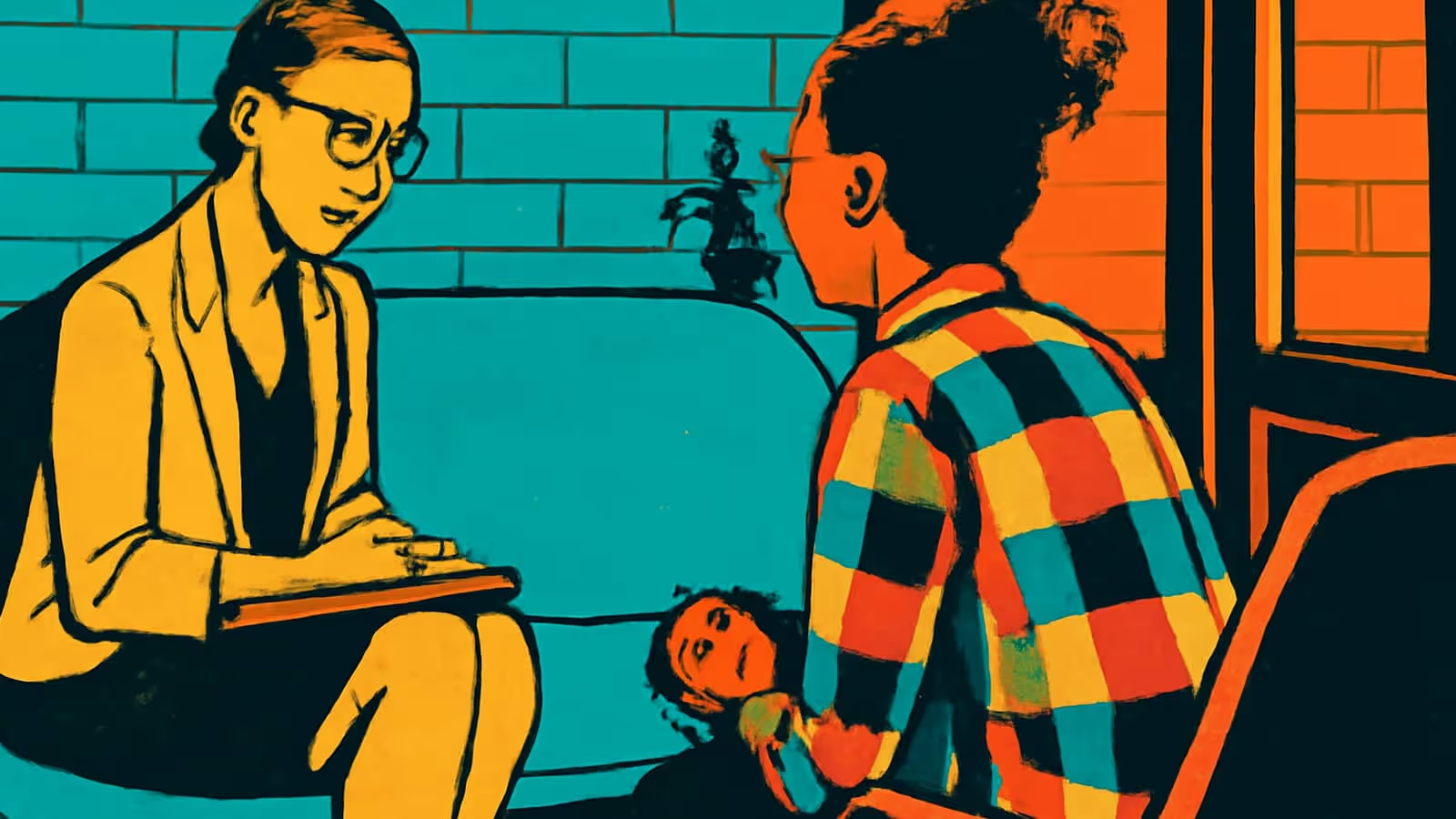
The World Health Organization deleted almost every personality disorder category from its classification and replaced them with a rating of severity plus a set of optional trait descriptions. [who-2019-icd11-pd] Only a borderline pattern survived, and it survived as a qualifier added on top of the severity rating rather than as a type in its own right.
Why the categories were dropped
Because they overlapped to the point of not carrying information. Assessed against the old list, most people met the criteria for several types at once, which meant the label described the process more than the person.
That is a specific failure rather than a matter of taste. A classification exists to divide things into groups that differ from each other, and a system in which the typical result is three or four labels simultaneously is not dividing anything. It also gave clinicians very little to act on: two people carrying the same category could need almost entirely different support, while two people with different categories could need the same.
What replaced them
Severity first, traits second, and the order is the point. A clinician rates how much difficulty there is in the person’s sense of self and in their relationships, and only then, optionally, describes which traits stand out.
| The old approach | The newer approach | |
|---|---|---|
| First question | Which type is this? | How severe is the difficulty? |
| What you get | A category, often several | A severity level, plus optional traits |
| Trait descriptions | Built into each type | Separate, and optional |
| Overlap between labels | Extensive | Not applicable, since there are no types |
| What survives of the old list | Everything | A borderline pattern qualifier only |
The five trait domains are negative affectivity, detachment, dissociality, disinhibition, and anankastia, which covers rigidity, perfectionism and an insistence on order. [who-2019-icd11-pd] They describe emphasis rather than membership: a person is not sorted into one, they are described as having more or less of each.
Two systems, two vocabularies for the same person
The manual used across much of North America still lists the familiar categories, so a person can be described in one vocabulary in one country and another vocabulary elsewhere with nothing having changed about them. [apa-dsm5-pd]
This is worth knowing before reading anything on the subject, because most of what is written online uses the older vocabulary and presents it as the settled state of the field. It is not wrong, exactly. It is one of two live systems, and it is the one the international body has moved away from.
What this means if you already have a label
Practically, very little changes on its own, and there is a question worth asking. Nobody rescinds a diagnosis because a manual was revised, and services move at their own pace, so most people find the old description still in use and newer paperwork phrased differently.
The useful question is what the newer framing would say: how severe the difficulty is judged to be, and which traits are prominent. Both connect more directly to a treatment plan than a category name does, and both are things you can ask about at a review. Our guide to borderline personality disorder covers the one label that survived, and our guide to narcissism covers the one most loosely used outside clinical settings.
What to ask at a review
Not a test, and it cannot tell you anything about a diagnosis. A prompt for what to ask if you already have a label and want it to be more useful than a name.
0 of 6 ticked
Collecting several labels over the years is exactly the overlap problem the revision was made to address, and it is a reasonable thing to raise. Ask what the picture looks like when described by severity and traits instead.
Ask about severity and prominent traits at your next review rather than about the category. Those are the parts a treatment plan is built from, and they are askable questions rather than a challenge to the diagnosis.
Little of this applies, which suggests the description you were given came with the detail that makes it useful. That is not the usual experience.
A reflection prompt, not a screener. No questionnaire on this site assesses personality disorder, and no online questionnaire can diagnose one.
Why the newer version is harder to write about
Because it is less quotable. A list of types with names and descriptions makes good copy, and a severity rating with five optional trait dimensions does not, which is a large part of why the old vocabulary persists in public writing long after the field moved.
The same caution applies to single traits that get treated as diagnoses in their own right. Persistent dishonesty is the clearest example, and our guide to when compulsive lying stops being a choice sets out how little the behaviour on its own tells you about what is underneath it.
That gap is worth holding on to when reading about this. The version that circulates is the one that reads well, not necessarily the one clinicians are moving toward, and a description that sounds satisfyingly specific is often specific about a category rather than about a person.
When to seek help
Speak to a doctor or a mental health professional if long-standing difficulties in relationships or in your sense of yourself are affecting work, friendships or your day-to-day functioning, whatever label has or has not been attached to them. Ask about severity and about what treatment is available rather than about which category fits, since that is the part that changes what happens next. If you are having thoughts of harming yourself, contact your local emergency services or a crisis helpline.
How MyFreud can help
Severity is judged partly on how much difficulty shows up in ordinary life over time, which is exactly the thing that is hard to convey in a twenty-minute review from memory. A record of how the weeks actually went gives that conversation something concrete to work from. Our personality guide covers what traits are and are not, and our borderline personality disorder guide covers the one category that survived the revision.
Download MyFreud and start today: App Store or Google Play.