
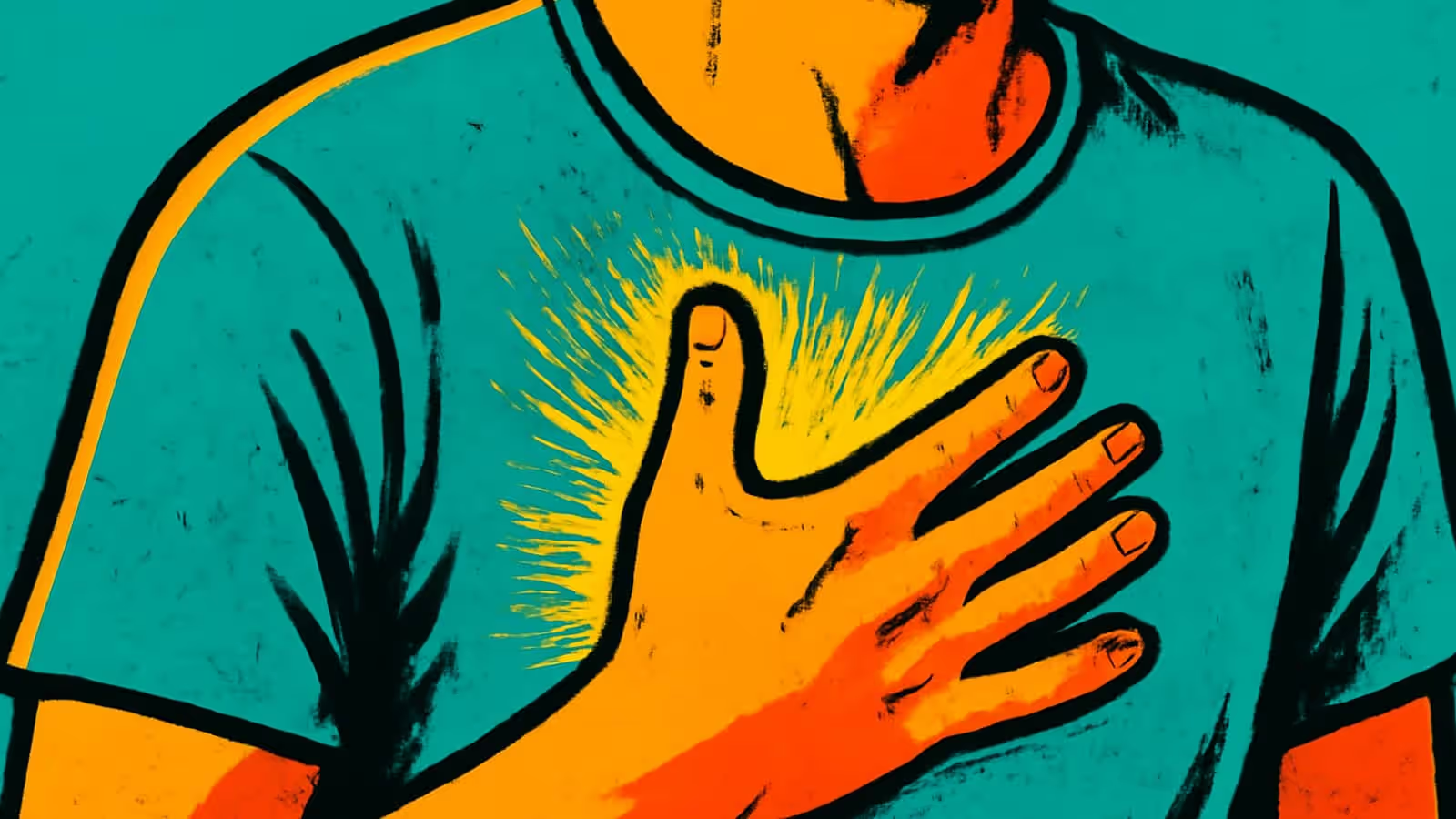
A panic attack peaks within about ten minutes and then subsides on its own, whether or not you do anything about it. [apa-2022-dsm5tr] That is in the diagnostic definition rather than being reassurance, and it is the most useful thing to know in advance, because waiting out something that ends by itself is a completely different task from trying to survive something with no end. This guide covers why it feels far longer, what genuinely extends it, and what the timing means practically.
Why it cannot last
The symptoms are driven by a surge of adrenaline, and the body clears adrenaline within minutes. Whatever else is true, the physiology that produces a racing heart, breathlessness and the sense of impending catastrophe cannot be sustained indefinitely. It is a system that fires hard and then has to stop.
That is why the ten-minute figure is not a comforting average but a structural fact about the mechanism. The attack is self-limiting by design, because the response it belongs to evolved for an emergency lasting seconds to minutes, not for an afternoon.
A schematic of the arc described in the panic literature: a peak within ten minutes, a long tail, and the wave pattern that vigilance produces. Values illustrate the shape, not measured intensity.
What people are actually counting
Three things stretch the reported duration, and only one of them is the attack.
Time perception distorts. Ten minutes of genuine terror is not experienced as ten ordinary minutes, and there is no reason it should be. People who time an attack afterwards are frequently surprised.
The aftermath gets counted in. Shakiness, exhaustion, a headache and a raw watchfulness for the next one can run for hours. That is real and it is depleting, and it is the tail rather than the event. Somebody who says an attack lasted all afternoon is usually describing this accurately, just with the wrong label.
Waves get counted as one long attack. A second attack twenty minutes after the first, driven by the fear of the first, feels like a continuation. Mechanically it is not, and that matters because what restarts it is the vigilance in between rather than the original trigger.
What actually makes it longer
Clark’s cognitive model of panic is the piece that explains the loop, and it is the most useful thing in this literature. [clark-1986-panic] An ordinary bodily sensation, a skipped heartbeat, a flush of heat, a moment of breathlessness, gets interpreted as a sign of catastrophe. The interpretation produces fear. Fear produces adrenaline. Adrenaline produces more sensations, which confirms the interpretation.
So the thing that extends a panic attack is the effort to stop it. Checking your pulse finds a fast pulse. Scanning your chest finds tightness. Each check is evidence that something is wrong, and each piece of evidence is another dose of adrenaline.
Hyperventilation contributes its own layer, and it is worth naming because it feels like the opposite of what it is. Breathing too fast lowers carbon dioxide, which produces dizziness, tingling and a sense of unreality, all of which read as further proof of catastrophe. [meuret-2010-hyperventilation] Our guide to derealisation covers that specific sensation.
What to do with the ten minutes
Knowing the number changes the task from surviving something endless to waiting out something finite, and that is a genuinely different psychological job.
The approach with evidence behind it is closer to allowing than to fighting. Name what is happening. Let the sensations be present without checking them. Do not attempt to make it stop, because attempting is the loop. This is not resignation and it is not easy, and it works precisely because the thing ends on its own.
Slowing the breath out helps, and specifically the out-breath rather than deep breathing, which frequently makes hyperventilation worse. Our guides to grounding during a panic attack and what a panic attack feels like cover the practical detail.
Waiting it out, on purpose
Practise the waiting when you are calm, so it is available when you are not. Set ten minutes. Sit with whatever is present and do not fix it: no checking your pulse, no scanning for symptoms, no making anything stop.
3:00
The skill is not relaxing. It is tolerating something without acting on it, which is exactly what an attack asks of you.
Ten minutes is roughly the length of the thing you are training for.
When to seek help
Have a first panic attack checked by a doctor. Chest pain, breathlessness and a racing heart have serious physical causes and those deserve ruling out properly rather than being assumed away.
Once physical causes are excluded, see a doctor if attacks are recurring, if you have started avoiding places in case one happens, or if fear of the next one is shaping your days. That avoidance is what turns panic attacks into panic disorder, and it is highly treatable. Ask about cognitive behavioural therapy for panic by name, which our guide to CBT for panic attacks covers, and see our pillar on panic attacks for the wider picture.
If you are having thoughts of harming yourself, seek help now rather than at the next available appointment. Contact your local emergency services or a crisis helpline.
How MyFreud can help
Attacks feel random and usually are not. Tracking mood alongside sleep, caffeine and what was happening beforehand tends to surface a pattern within a few weeks, and knowing what precedes them is what turns the ten minutes from an ambush into something you can see coming.