
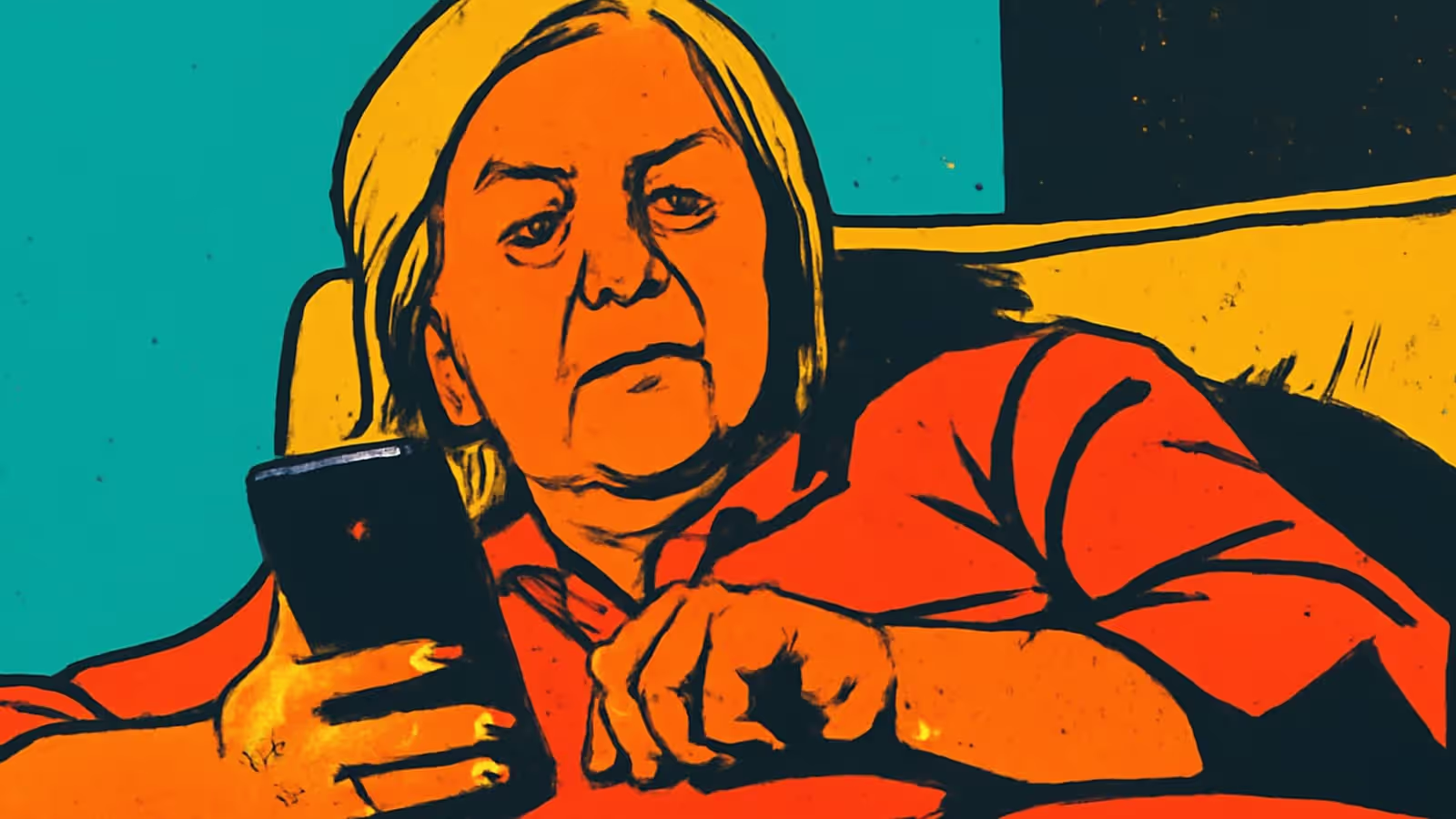
Political anxiety is what happens when an event stream you cannot influence starts deciding how your day goes. It is ordinary anxiety wearing an unusual trigger, and the reason it is so persistent has less to do with how bad the news is than with the fact that it never finishes.
Most advice on this arrives as a single instruction to switch off, which nobody who cares about the subject is going to follow. The more useful question is which parts of the habit are producing the arousal, because they are not the parts people assume.
What political anxiety actually is
It is anxiety maintained by political events, and there is no separate diagnosis for it. The symptoms are the familiar ones: broken sleep, a tight chest, a mind that returns to the same subject during dinner, irritability with people who have nothing to do with any of it.
What distinguishes it is the shape of the trigger rather than the feeling. Anxiety is built to mobilise you against a specific threat and then subside once you have acted. Politics offers a threat that is real, slow, collective, and almost entirely outside what one person can change between now and Thursday. The alarm goes off correctly and then has nowhere to discharge.
That mismatch explains something people find confusing about themselves, which is that being well informed does not help. Reading a fourth analysis of the same event adds arousal without adding any action, so the loop closes on itself. The people who report the heaviest toll from politics are rarely the best informed. They are the ones checking most often.
Why the news is unusually good at producing anxiety
Because coverage is selected for exactly the properties that trigger the body’s alarm system, and delivered in a format with no ending. Threat, conflict and unpredictability are what hold attention, so they are what surfaces.
Two features make it stickier than other stressors. The first is availability. A stressful meeting happens at 2pm and is over; political news is there at 6am, at lunch, and at 11.40pm when you have already put the light out. The second is interruption. Each item arrives before the previous one has resolved, so the closing signal that would normally end the arousal never comes.
The timing of intake matters more than the amount, which is the part most people get wrong.
A schematic of the pattern described in this article, drawn to show shape rather than measured values.
Reading before you are properly awake sets a baseline that the rest of the day is measured against, and reading in bed at night gives the material several unbroken hours to circulate. The same quantity of information, moved to a window in the middle of the day, costs far less. Our piece on doomscrolling and mental health covers the mechanics of the scroll itself in more detail.
What the research says it costs
More than most people admit to out loud. A representative survey of US adults, published in 2019, built and validated measures of the physical, social and emotional costs of political engagement, and found a large number of respondents believed their physical health had been harmed by exposure to politics, with even more reporting emotional costs and lost friendships. [smith-costs-of-politics]
Two things about that finding are worth keeping straight. It is self-reported belief about harm rather than a measured clinical outcome, so it does not establish that politics caused a diagnosis. And it was conducted in one country, so the exact proportions do not transfer. What it does establish is that the costs are widespread rather than the preserve of a small number of unusually fragile people, and that the social cost, lost friendships, is larger than the health cost people usually lead with.
Chronic activation of the stress response has downstream effects on sleep, concentration and mood regardless of what triggered it. [apa-stress-politics] The trigger being political does not make the physiology different.
Why diagnosing a politician from your sofa makes it worse
Because it converts a feeling you could act on into a puzzle you cannot solve. The single most common thing people do with political anxiety is try to work out what is psychologically wrong with a leader, and it is close to the least effective use of the energy.
Donald Trump is the clearest illustration, because more amateur psychological assessment has been attached to him than to any living politician, and because the professional bodies had to say something about it. The relevant principle is old: psychiatrists are told not to offer a professional opinion about a public figure they have not personally examined and who has not consented to it. The reason is not politeness. An assessment made from television and reporting is not an assessment, it is pattern-matching on an edited public performance, and a label attached that way is unfalsifiable and therefore endless.
That endlessness is the problem for you specifically. Speculation about somebody’s inner life has no stopping condition, generates no action, and can be resumed at 3am indefinitely. If you notice you have spent forty minutes on it, you have not been following politics. You have been ruminating with a political subject, which is a different activity and responds to different remedies. Our guide to rumination covers those.
What actually reduces it
Timing, format and one piece of action. Caring less is not on the list, partly because it does not work and mostly because nobody wants it.
Give the news a window and a wall. Two fixed slots, neither of them within an hour of waking or an hour of sleeping, and nothing in between. The wall matters more than the slot. Most of the arousal comes from the checks you did not plan, and those are the ones that feel like nothing.
Choose a format that ends. A daily briefing, a printed paper, a weekly summary: anything with a last page. A feed has no last page by design, so the only thing that ends a session is exhaustion or interruption, and neither leaves you feeling finished.
Move the phone out of the bedroom. This is the single change with the largest effect for the least negotiation, because it removes both the worst intake window and the worst rumination window at once.
Do one thing that is local and finite. Not because a local action fixes a national problem, but because the anxiety is asking for an action and will keep asking until it gets one. A donation, an hour of something, a letter, a shift somewhere. The size does not matter; the completion does.
Have one conversation with somebody who disagrees, in person, about something concrete. This is uncomfortable and it is the fastest correction available for the sense that the other side is a monolith, which is a large part of what makes the whole subject frightening. Where that division has already reached your own family, our guide to the us vs them mentality covers what holds a relationship together across it.
Is the news habit costing you something?
Tick anything true of the last two weeks. This is a reflection prompt rather than a test, and it produces no diagnosis.
0 of 6 ticked
This is the pattern the timing changes above are aimed at. Start with the phone leaving the bedroom, which usually takes two of these items with it, and give it a fortnight before judging.
Worth picking the single item that annoys you most and changing only that. Partial changes hold better here than a full reset, which tends to collapse into a binge.
Your intake is not costing you much at the moment. Worth rereading in an election month, when the pattern changes for almost everybody.
If the worry keeps running when you are away from any political input, the subject has stopped being the driver. That is worth reading about in the anxiety guide, and it points toward general anxiety rather than a news habit.
When to seek help
Speak to a doctor or a therapist if sleep is disturbed most nights, if you cannot concentrate on work or family for stretches at a time, if you are avoiding people you used to see, or if the worry continues on days you read nothing. Those are the markers that separate an expensive habit from an anxiety problem that will not resolve on its own.
Ask for cognitive behavioural therapy by name. It has been tested extensively for generalised anxiety and a meta-analysis of trials found it effective, so this is a treatable presentation rather than a temperament you are stuck with. [cuijpers-gad] Go sooner if you are drinking more than you were, if anger is affecting your relationships, or if you feel hopeless about the future in a way that has stopped being about any particular event.
Contact your local emergency services or a crisis helpline if you feel unsafe or have thoughts of harming yourself.
How MyFreud can help
MyFreud is a mobile app that helps you find solutions to problems that have affected your mind and productivity. Live coaching sessions give you somewhere to argue the thing out with a person who has no side in it, and each one ends with an actionable plan rather than a summary of the situation. Daily tracking is the part that settles this particular question, because it shows whether your worst days follow your heaviest reading days or run independently of them, and those two answers point to different fixes. The notepad is where the one local, finite action goes, so it stops being an intention.
Download MyFreud and start today: App Store or Google Play.