
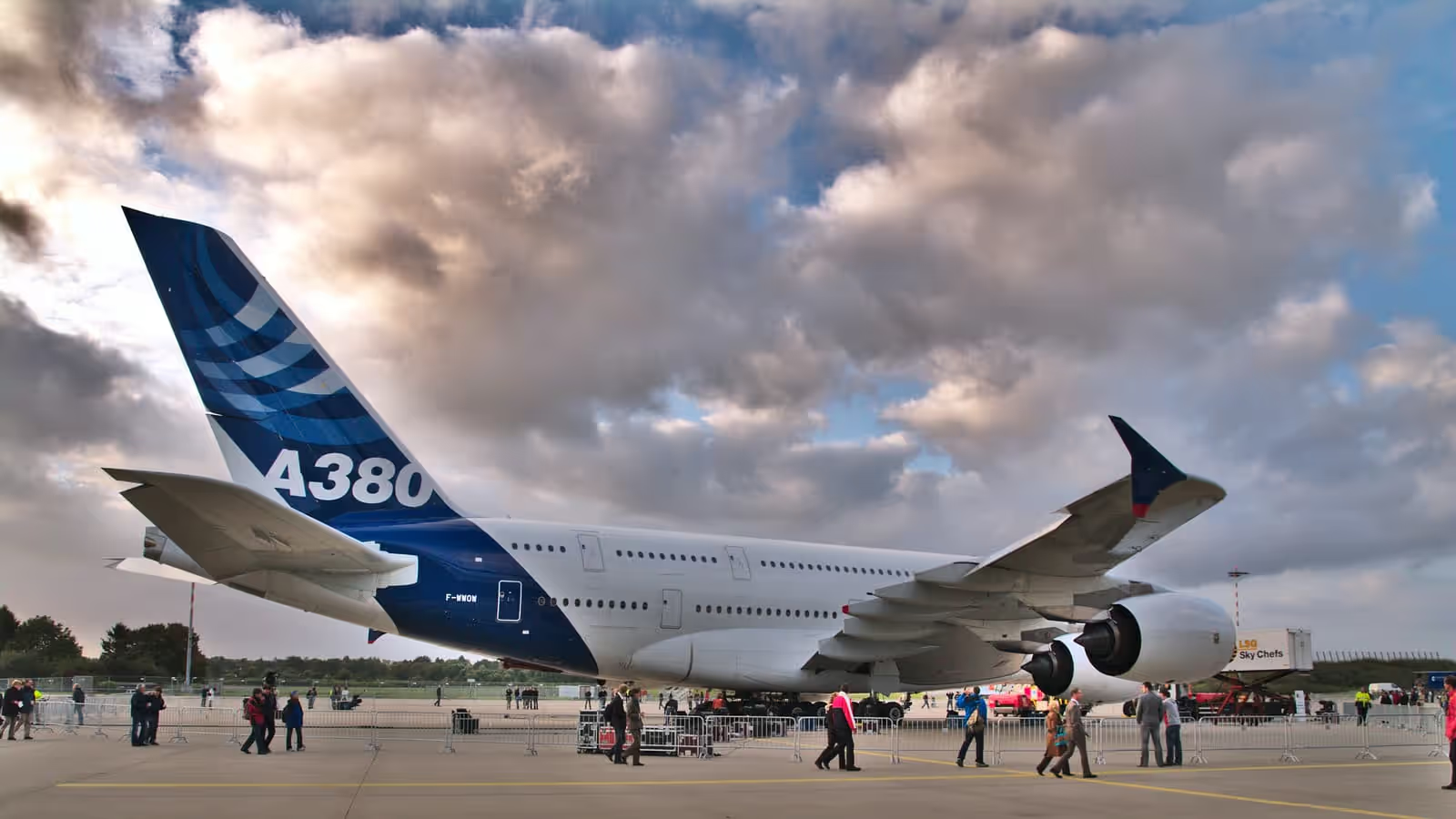

The Airbus A380 spent this week in the search charts, which happens whenever aviation is in the news, and a predictable share of that traffic is people who are about to fly and would rather not be. If you are one of them, the most useful thing to say first is that you are probably not confused about the statistics. Being told again that flying is safe is the standard response, and it is the standard response because it is easy, not because it works.
Why the numbers do not help
Because the fear is not generated by a mistaken belief about probability. Most people who are frightened of flying can recite the safety record accurately, and remain frightened, which is exactly what you would expect if the numbers were never the mechanism.
This matters practically rather than philosophically. If the problem were a factual error, information would fix it, and for a small number of people it does. For most, being handed the statistics again lands as evidence that the person offering them has not understood the problem, which is why reassurance from a well-meaning friend at the gate so reliably fails.
What the fear is usually about
Being trapped, and having no control. Once you look at where the fear actually spikes, the pattern is consistent and it is not about impact.
- It often peaks at the door closing, not at take-off. The moment of no return is the trigger, and nothing about the aircraft’s risk changed at that second.
- A middle seat is worse than a window, which makes no sense in terms of danger and complete sense in terms of confinement.
- Many of the same people are fine in a car, which is far more dangerous per mile and leaves them able to pull over.
- The fear frequently attaches to a panic attack rather than to a crash: the real dread is having one at 35,000 feet with no exit, which is a fear about the fear.
That last one is why fear of flying and panic overlap so heavily, and why our panic attacks guide is often more relevant than anything about aviation.
- Being trapped and unable to leave 41%
- Having a panic attack with no exit 27%
- Not being in control 20%
- The aircraft actually crashing 12%
A schematic of the components described in this article, to show relative share rather than measured data.
The noises, in order
A surprising amount of the fear is generated by unexplained sounds, and naming them removes it. Anxiety attaches readily to anything unexpected, and an aircraft makes a sequence of alarming noises that all mean something ordinary.
- A loud whirring before pushback is usually the auxiliary power unit or hydraulics, not an engine problem.
- A thud and a rising whine on the runway is the engines spooling up.
- A clunk shortly after take-off is the landing gear retracting, and it is meant to be audible.
- The engine note dropping a few minutes in is thrust reduction at altitude, a planned step and not a failure.
- Grinding and buzzing on approach is flaps and slats extending.
- A bang and a roar on landing is reverse thrust.
The predictable version of this is worth rehearsing, because the fear is generated by surprise as much as by danger. Knowing the sequence turns each event from evidence something is wrong into confirmation the flight is proceeding normally.
Turbulence
Turbulence is a comfort problem rather than a structural one. Wings are designed and tested to flex far beyond anything ordinary weather produces, and the sensation of a bad patch is much closer to a car on a rough road than to anything failing.
The genuinely useful piece of information is about what the actual risk in turbulence is: it is being unrestrained inside the cabin. That is why the standing advice is to keep your belt loosely fastened whenever you are seated, and it is a rare case where the reassuring fact and the safety instruction are the same thing.
A four-minute settle, for the seat
For the door closing, or a rough patch. Breathe out for longer than you breathe in, roughly four in and six out, and let the timer rather than the turbulence decide when you are finished. The point is not to stop the fear but to stay in the seat while it falls on its own.
4:00
Feet flat, hands loose. If the fear rises, that is expected and it is not a sign the technique is failing.
Done. Notice that it dropped without anything about the flight changing.
What actually treats it
Exposure-based cognitive behavioural therapy, which has the strongest evidence for specific phobias and is one of the shortest courses in mental health. [apa-phobia] It frequently runs to a handful of sessions rather than months.
The mechanism is worth stating because it explains everything else in this article. Repeated, planned approach to the thing you avoid lets the fear response fall on its own, and the learning that matters is not that flying is safe but that the fear itself subsides without you doing anything about it. That is why the treatment cannot be delivered by information, and why anything that helps you avoid feeling the fear works against it.
Which is the honest answer on alcohol and sedatives. Getting through a flight without experiencing the fear prevents exactly the learning the treatment depends on, so it tends to make the next flight harder. Where something is prescribed for a specific journey, that is a decision to make with a doctor rather than alone. [apa-anxiety-flying]
Virtual reality is now commonly used for the early stages, which solves the awkward practical problem that exposure to flying is expensive and hard to repeat. Our guides to how to deal with anxiety and grounding techniques cover the in-the-moment part, and the anxiety guide covers the wider picture.
Which fear is yours?
Tick anything true of how it actually feels. This is a reflection prompt rather than a test, and it produces no diagnosis.
0 of 6 ticked
That combination points at being trapped and at fear of the fear rather than at any belief about aircraft, which is good news, because it is the version exposure-based treatment handles best and it is a short course. Ask for cognitive behavioural therapy with exposure by name. The last item matters most: avoidance is what keeps a phobia in place.
This is the ordinary shape of it. The single most useful thing before your next flight is rehearsing the noise sequence above, because a large share of the fear is generated by surprise rather than by danger.
Nothing here matched, which suggests nerves rather than a phobia. Our article on the difference between nervous and anxious covers where that line sits.
The same mechanism drives every specific phobia, and our pillar on phobias covers it in general: why avoidance strengthens the fear it seems to manage, and why one long session of guided exposure is often enough.
When to seek help
Speak to a doctor or a therapist if you are declining trips, work opportunities or family occasions in order to avoid flying. Avoidance is both the clearest sign it has become a phobia rather than a dislike, and the specific thing that keeps it in place, so it is the marker worth acting on rather than waiting out.
Go sooner if you are drinking to manage flights, if the anticipatory dread is starting weeks in advance, or if you have had a panic attack on board. Ask for exposure-based cognitive behavioural therapy by name.
Contact your local emergency services or a crisis helpline if you feel unsafe or have thoughts of harming yourself.
How MyFreud can help
MyFreud is a mobile app that helps you find solutions to problems that have affected your mind and productivity. Live coaching sessions give you somewhere to work out whether the fear is about the aircraft or about being trapped, which decides what actually helps, each one ends with an actionable plan rather than reassurance, daily tracking shows the anticipatory dread building before a trip, and the notepad holds the noise sequence and the plan for the seat.
Download MyFreud and start today: App Store or Google Play.